
✨ This article was AI edited. Editorial responsibility: Stampostage.info.
Produced with AI. This article was artificially generated. Editorial responsibility: Stampostage.info.
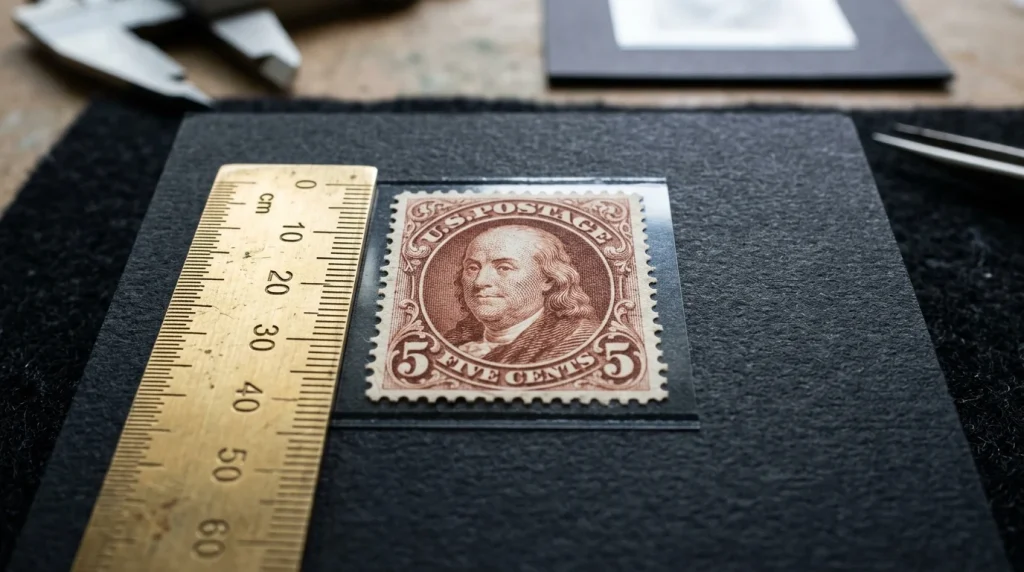
5 cent stamps worth money are rare, historic United States postage issues—such as the 1847 5¢ Benjamin Franklin (Scott #1, valued up to $25,000+), the 1856 5¢ Thomas Jefferson imperforate, the 1867 F-Grill varieties, and the famous 1917 5¢ red color error (Scott #467/505)—that command between $500 and $30,000+ at public auction due to extreme scarcity, paper variety anomalies, and pristine condition grading.
For more than a century, the five-cent denomination held a central role in American postal tariffs. In 1847, five cents paid the standard rate for a half-ounce letter traveling under 300 miles within the United States. In subsequent decades, five cents covered international treaty rates, transpacific mailings, and registered letters. Because the five-cent denomination spanned every major philatelic printing era—from nineteenth-century hand-engraved classic bank note issues to early twentieth-century rotary press experiments—certain 5-cent stamps rank among the most valuable and fiercely contested treasures in American philately.
Top 7 Most Valuable 5-Cent US Postage Stamps
While millions of modern 5-cent stamps from the 1950s and 1960s (such as the 1962 George Washington or 1968 Francis环境变量) are worth only face value, these seven historic issues represent high-value rarities:
| Stamp Issue & Denomination | Issuance Year | Scott Catalog # | Primary Subject / Design | Estimated Auction Realization (Sound VF) |
|---|---|---|---|---|
| 1847 5¢ Benjamin Franklin | 1847 | Scott #1 | Franklin portrait engraved in red-brown ink; America’s first official federal postage stamp. | $800 – $25,000+ (MNH copies exceed $35,000) |
| 1856 5¢ Thomas Jefferson (Type I) | 1856 | Scott #12 | Imperforate, red-brown ink; full outer frame projections intact. | $900 (used) – $14,000 (mint) |
| 1867 5¢ Jefferson with F-Grill | 1867 | Scott #95 | Brown ink; features 9 × 13 mm embossed waffle pattern (grill) on paper reverse. | $1,200 (used) – $18,000 (mint) |
| 1875 5¢ Zachary Taylor (Continental) | 1875 | Scott #179 | Deep blue line-engraving; issued for Universal Postal Union (UPU) international letter rates. | $150 (used) – $3,500 (MNH) |
| 1893 5¢ Columbus Soliciting Aid | 1893 | Scott #234 | Chocolate brown pictorial; Columbus presenting his New World voyage plans to Queen Isabella. | $40 (used) – $850 (certified Gem 100) |
| 1898 5¢ Trans-Mississippi Issue | 1898 | Scott #288 | Dull blue; “Fremont on the Rocky Mountains” raising the US flag. | $60 (used) – $1,200 (MNH) |
| 1917 5¢ Red Error (Washington) | 1917 | Scott #467 / 505 | Engraver inadvertently etched 5¢ transfer die onto 2¢ Carmine plate (Plates 7942). | $450 (single) – $3,500 (block of 9 with 2¢ stamps) |
In-Depth Analysis of the Premier 5-Cent Rarities
1. The 1847 5-Cent Benjamin Franklin (Scott #1)
Authorized by an Act of Congress on March 3, 1847, the 5¢ Franklin represents the dawn of uniform, prepaid federal postal delivery in the United States. Engraved by Rawdon, Wright, Hatch & Edson of New York City, it was printed on thin wove paper without perforations (imperforate), requiring postal clerks to cut individual stamps from the sheet using hand shears.
Because the stamps were cut manually, surviving copies with four wide, clear margins that do not cut into the engraved framelines are scarce. A standard used copy with typical close margins sells for $500 to $900, while a certified sound copy with huge sheet margins easily exceeds $3,000. Intact original covers postmarked in red, blue, or green ink routinely fetch $1,500 to $8,000 at auction.
2. The 1856 5-Cent Thomas Jefferson Imperforate (Scott #12)
Printed by Toppan, Carpenter, Casilear & Co., this deep red-brown stamp depicted Thomas Jefferson from a portrait by Gilbert Stuart. Used predominantly on correspondence bound for Europe via British packet steamers, surviving copies are notoriously difficult to find with four clear margins because the plate spacing between individual stamp designs was barely half a millimeter. Sound examples with intact outer ornamental projections command thousands of dollars.
3. The 1917 5-Cent Red Error of Color (Scott #467, 485, 505)
The 5¢ red error is one of the most famous production blunders in United States philately. In late 1916, a plate maker at the Bureau of Engraving and Printing was repairing three damaged impressions on a 400-subject steel printing plate (Plate #7942) designed for the common 2-cent Washington stamp. By accident, the worker selected the wrong transfer roll—a 5-cent die instead of a 2-cent die—and rolled three 5-cent designs onto the 2-cent plate!
The sheet was subsequently inked with the standard carmine-red ink used for 2-cent stamps. As a result, sheets containing 397 two-cent stamps and three five-cent stamps in identical red ink were distributed across post offices. Today, an authentic 5¢ red error—especially when preserved in a block of nine attached stamps showing the 5¢ error flanked by eight normal 2¢ stamps—is a prized, valuable trophy asset.
Why Most 5-Cent Stamps Are NOT Valuable
While the classic nineteenth-century issues detailed above command hundreds or thousands of dollars, the vast majority of 5-cent stamps discovered in inherited albums were printed in the mid-twentieth century and have minimal commercial value:
- The 1962 5¢ George Washington (Scott #1213): Printed in quantities exceeding 35 billion copies to meet First-Class letter rates between 1963 and 1968. It is one of the most common postage stamps in human history and is worth only face value ($0.05).
- The 1965 Prominent Americans 5¢ George Washington (Scott #1283): More than 10 billion copies produced. Surviving mint sheets trade at 20% to 30% discount below face value as discount business postage.
- 1960s Commemoratives: Issues honoring American doctors, Florida settlement, Homemakers, and Shakespeare were printed in runs of 120 million each. They possess zero financial premium over face value.
How to Test Your 5-Cent Stamp for Genuine Rarity
To determine whether your 5-cent stamp is a valuable classic variety or a common twentieth-century reprint, apply these three diagnostic checks:
- Check for Perforations: If the stamp has smooth, straight cut edges on all four sides without perforations (holes), it is an imperforate classic printed between 1847 and 1857. Inspect the margins carefully under magnification.
- Measure Paper Grills (Reverse Side): Turn 1860s Jefferson stamps face down under raking side lighting. Look for an embossed rectangular grid of tiny pyramidal points (called a “grill”) pressed into the paper fibers to prevent cancellation washing. The exact count and millimeter dimensions of the grill points (e.g., F-Grill vs. E-Grill) can increase value from $50 to over $10,000.
- Examine Ink Color and Denomination: For early twentieth-century Washington stamps, verify whether the word “FIVE CENTS” appears in red (carmine) ink rather than the standard blue. A genuine 5¢ stamp in red ink represents the famous 1917 color error.
Frequently Asked Questions on Valuable 5-Cent Stamps
How can I tell if my 5-cent Benjamin Franklin stamp is genuine?
The 1847 5¢ Franklin (Scott #1) was printed on thin, semi-translucent grayish-white or bluish paper without perforations. The engraving is razor-sharp, showing individual lines in Franklin’s cravat and hair. Beware of modern facsimiles and reproductions produced for philatelic exhibitions (such as the 1947 centenary souvenir sheet), which feature tiny modern initials or different perforation characteristics.
What is the most expensive 5-cent US stamp ever sold?
The highest price recorded for a 5-cent US stamp was paid for an 1847 5¢ Franklin (Scott #1) in certified Gem 100 condition with colossal margins, which realized over $45,000 at a Robert A. Siegel auction. Furthermore, rare Postmasters’ Provisionals issued in 1845 prior to federal postage (such as the 5¢ Alexandria or 5¢ Millbury provisionals) have sold for hundreds of thousands of dollars.
Can I still use old 5-cent stamps to mail letters?
Yes. All United States stamps issued from 1861 to the present day remain completely valid for postal use at their printed face value. You can affix twenty 5-cent stamps onto an envelope to cover a $1.00 postage tariff, though doing so with genuine classic rarities would destroy thousands of dollars in collector value!
Get our latest guides, news, and insights highlighted in your Google Search & AI Overviews.