
✨ This article was AI edited. Editorial responsibility: Stampostage.info.
Produced with AI. This article was artificially generated. Editorial responsibility: Stampostage.info.
To check your stamps value, identify the issuing postal country, denomination, and year of release; inspect the condition grade (centering, margins, and paper soundess); check gum integrity (Mint Never Hinged vs. Used); and cross-reference the physical attributes against verified auction realization archives or standard catalog references (Scott, Stanley Gibbons, Michel).
Every day, individuals who inherit stamp albums, find old correspondence in a desk drawer, or decide to organize childhood collections wonder: how do I check my stamps value without spending hundreds of dollars on professional appraisal fees? With millions of different stamp designs issued worldwide since Great Britain introduced the Penny Black in 1840, appraising stamps can feel overwhelming. Fortunately, modern digital scanning tools, free online databases, and standardized cataloging systems make self-appraisal accessible to anyone willing to follow a systematic methodology.
The 5 Fundamental Steps to Check Your Stamps Value
Self-appraising a collection requires a disciplined, step-by-step process. Skipping steps often leads to severe misidentification—such as mistaking a standard 5-cent stamp for an ultra-rare rotary press anomaly.
| Evaluation Step | Primary Objective | Key Tools / Resources Required | Critical Pitfall to Avoid |
|---|---|---|---|
| Step 1: Country & Issuer Identification | Determine the exact issuing postal administration. | Stamp identifier guide; Latin country dictionary; magnifier. | Assuming stamps without country names are errors (Great Britain stamps feature only the monarch’s silhouette without a country name). |
| Step 2: Condition & Soundness Inspection | Audit centering, perforations, tears, thins, and stains. | 10x–20x triplet loupe; stamp tongs; black background card. | Handling stamps with bare fingers or attempting to clean paper with water or solvents. |
| Step 3: Gum & Postmark Classification | Determine if the stamp is Mint Never Hinged (MNH), Mint Hinged (MH), or Used. | Raking oblique light; good lighting. | Assuming an uncancelled stamp is automatically mint (many have had cancellations chemically washed away). |
| Step 4: Technical Diagnostics | Measure perforation count, paper watermark, and plate printing dimensions. | Perforation gauge (instanta); watermark tray and non-toxic fluid; precision millimeter ruler. | Guessing perforations by eye; confusing millimeters with imperial fractions. |
| Step 5: Catalog Cross-Referencing | Match the item against standardized catalog numbers (Scott, Stanley Gibbons) and recent completed sales. | Library reference catalogs; eBay “Sold Items” filter; Siegel Auction Power Search. | Relying on active, unsold online listings with speculative asking prices. |
Top Free Digital Tools to Identify and Price Stamps
Technological advancements have created powerful digital tools that allow collectors to photograph a stamp and receive instant identification data:
1. Visual AI Identification Apps (Stamp ID Pro / Colnect / HipStamp)
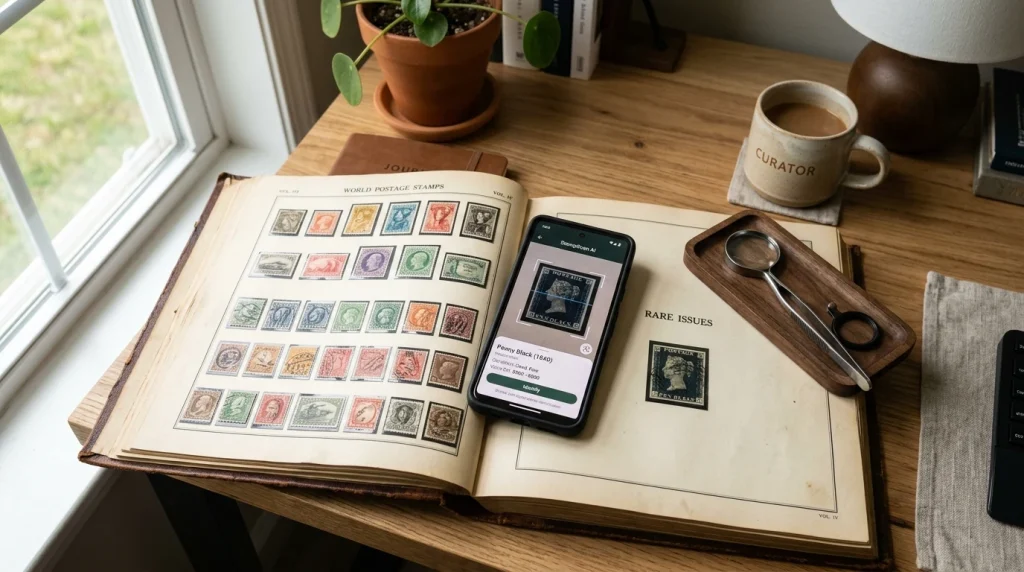
Modern mobile applications utilize neural visual search models trained on millions of philatelic images. By taking a clear, well-lit photo of an unknown stamp, the app matches the design, colors, and denomination against international databases, providing the probable catalog number, issuance year, and country of origin within seconds. While excellent for broad identification, remember that apps cannot evaluate micro-perforations, watermark variations, or paper repairs.
2. Free Online Philatelic Databases (Colnect / StampWorld)
Websites such as Colnect and StampWorld host exhaustive digital catalogs with high-resolution imagery and estimated values for nearly every stamp ever printed worldwide. You can filter by year, theme, denomination, and format to locate exact matches and track inventory.
3. Completed Marketplace Sales (eBay / Delcampe)
To discover what real buyers are actively paying in cash right now, search eBay or Delcampe for the specific country and stamp subject. Crucial step: navigate to the left-hand search filter and toggle on “Sold Items” / “Completed Items.” This filters out unrealistic asking prices and reveals confirmed market transactions from the past 90 days.
Decoding Country Names on Foreign Stamps
A frequent hurdle when checking stamp values is identifying foreign postal administrations whose names differ from modern English geography. Keep this quick translation table on hand:
| Inscription on Stamp | Issuing Country / Administration | Approximate Historical Era |
|---|---|---|
| No country name (Monarch portrait only) | Great Britain (United Kingdom) | 1840 to Present |
| Helvetia | Switzerland | 1850 to Present |
| Deutsches Reich / Deutschland | Germany (Imperial / Federal) | 1872 to Present |
| Magyar Posta | Hungary | 1871 to Present |
| Suomi | Finland | 1856 to Present |
| CCCP / Rossiya | Soviet Union (USSR) / Russia | 1923–1991 / 1992–Present |
| Espana / Correos | Spain | 1850 to Present |
| Nippon / 日本郵便 | Japan | 1871 to Present |
The 4 Physical Attributes That Determine Actual Worth
Two stamps from the same original sheet can differ in value by a factor of 100 based entirely on condition. When checking your stamps value, evaluate these four physical criteria:
1. Centering and Margins
Look at the white borders surrounding the central printed image. Are they wide, balanced, and equidistant on all four sides?
- Superb / Gem: Flawless centering. The image sits exactly in the geometric center of the paper rectangle.
- Very Fine (VF): Well-centered; margins are clear of the design, with only minor visual bias toward one edge. Catalog prices assume this grade.
- Fine (F): The perforations closely approach or lightly touch the printed frame line. Value drops to 20%–30% of catalog levels.
- Average / Poor: The perforations cut deep into the design. Value drops to near zero for common stamps.
2. Gum Condition (Unused Stamps)
Turn the stamp over to inspect the reverse adhesive:
- Mint Never Hinged (MNH): Pristine, smooth original gum untouched since the day it left the post office. Commands the highest prices.
- Mint Lightly Hinged (MLH): Features a minor shadow or mark where an album hinge was peeled away. Valued at 30% to 60% of MNH price.
- No Gum / Washed: The gum has been removed by water immersion. Commands minimal value for modern issues.
3. Hidden Physical Flaws (Faults)
Inspect the stamp against a bright light source or resting in black watermark fluid to expose hidden structural flaws:
- Hinge Thins: Areas where paper fibers were ripped away when a hinge was forcefully peeled. Thins reduce commercial value by 70% to 90%.
- Creases and Bends: Structural wrinkles in the paper fibers caused by improper storage.
- Tears and Pinholes: Even a microscopic edge tear destroys collector demand for all but the rarest classic issues.
4. Cancellation Cleanliness (Used Stamps)
For used stamps, light, readable circular date postmarks (CDS) that leave the central face or vignette unobstructed are preferred. Heavy, smudged black obliterator bars, pen cancels, or grease marks significantly depress value unless the postmark represents a rare territorial or historical routing cancel.
Frequently Asked Questions on Checking Stamp Values
Can I check stamp values by scanning them with my phone?
Yes, visual search apps (such as Google Lens, eBay Image Search, or Stamp ID Pro) are excellent for quickly identifying the country, year, and subject matter of a stamp. However, image recognition software cannot verify micro-perforation counts, hidden paper thins, watermark types, or gum alterations. Use visual apps as an initial sorting tool, then verify technical details manually.
Why are almost all modern stamps worth face value or less?
From the mid-1930s through the late 1980s, stamp collecting was a mass consumer craze. Millions of families bought full sheets of new commemorative issues from the post office and stored them safely in glassine envelopes. Because hundreds of millions of these mint stamps survive today, supply vastly outstrips collector demand, causing them to trade at wholesale discounts for everyday postal mailing.
What should I do if I think I found a rare stamp?
Do not attempt to clean, iron, or remove the stamp from its envelope or album page. Place the specimen inside an acid-free glassine envelope or clear plastic mount. Cross-reference the item against specialized catalogs at your local library, or take it to a regional meeting of an accredited philatelic club for informal inspection by seasoned collectors.
Get our latest guides, news, and insights highlighted in your Google Search & AI Overviews.