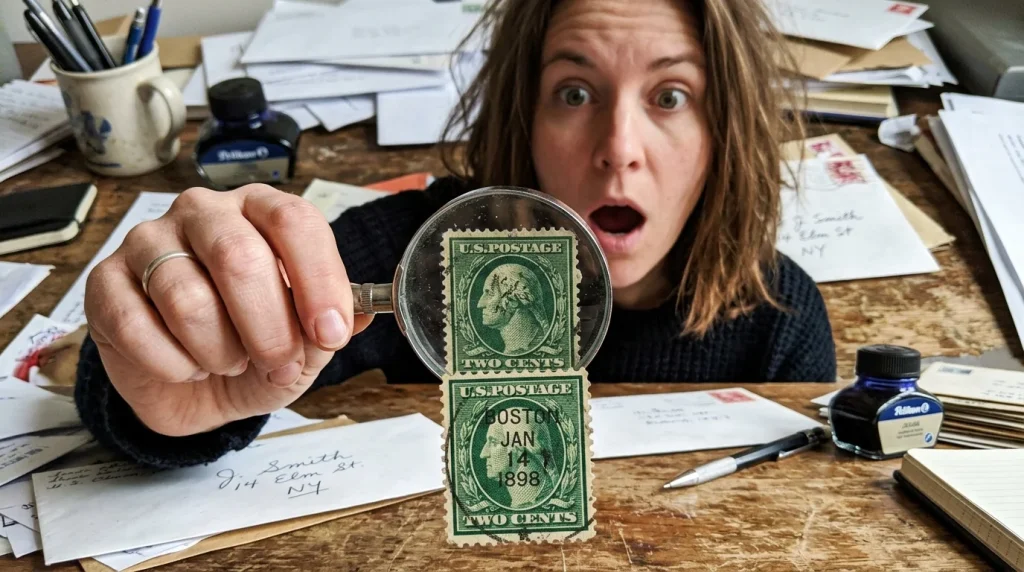

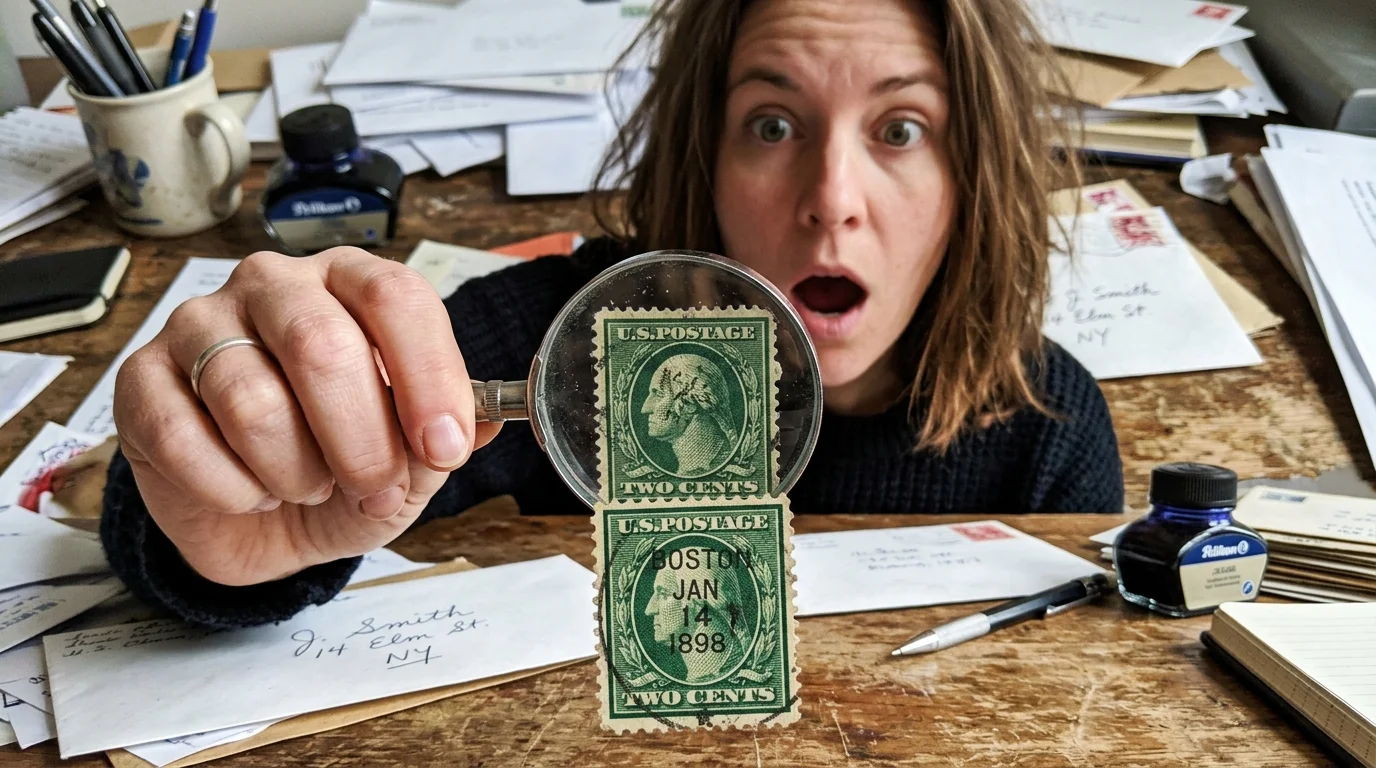
The true old green 2 cent stamp value typically ranges from $0.05 to $0.25 for a standard, used George Washington issue found in most household collections. Because the United States government printed billions of these stamps throughout the early 20th century to meet everyday mailing demands, the vast majority carry almost no financial premium today.
Recently, social media feeds have exploded with viral videos claiming everyday people are finding fortunes in their attics.
These clips show a seemingly identical green stamp fetching thousands of dollars at high-end auction houses. This creates massive confusion for casual collectors who suddenly believe their childhood album holds a winning lottery ticket.
However, a specific micro-measurement separates a worthless piece of paper from a documented rarity. And this detail is something 99% of people completely overlook when examining their collection.
Why Viral Videos Mislead People About Auction Value
Short-form videos thrive on shock value, intentionally omitting the strict physical criteria that determine genuine auction value.
Content creators flash a picture of a standard stamp alongside a headline-grabbing price tag, but they fail to explain the technical grading system behind the appraisal.
They ignore the fact that high payouts only happen when collectors stumble upon documented rare versions featuring microscopic printing errors or unique paper compounds.
When you see a record-breaking sale on social media, you are looking at a historical anomaly.
These astronomical prices apply exclusively to stamps that survived a century without a single structural flaw, or those stemming from an extremely limited experimental print run that the post office quickly recalled.
Just as there are dozens of green George Washington stamp variations, the 2-cent category is packed with visually identical twins that possess vastly different actual values.
Without specialized philatelic tools, an untrained eye simply cannot spot the microscopic difference between a five-cent stamp and a five-thousand-dollar rarity.
The Washington-Franklin Series: A Brief History
Between 1908 and 1922, the United States Postal Service released one of the most complex stamp sets in history.
Known by experts as the Washington-Franklin Series, this era produced over 200 distinct stamp varieties featuring just two founding fathers.
The Bureau of Engraving and Printing constantly tweaked their manufacturing techniques during these years to cut costs, prevent counterfeiting, and improve mass production efficiency.
These ongoing production changes created an identification nightmare for modern collectors.
The government experimented with different paper types, varying watermarks, and entirely new printing presses over a fourteen-year span.
Because the core profile design remained virtually unchanged for over a decade, distinguishing between the different issues requires a forensic approach.
A stamp printed in 1912 might look exactly like one printed in 1914 to a casual observer, but changes in the underlying paper structure dictate their respective values today. Collecting these stamps demands patience and a willingness to examine the physical chemistry of the paper itself.
How to Check for Secret Marks and Engraving Variations
To accurately identify your specific stamp, you must look closely for intentional secret marks left by the original master engravers.
The Bureau implemented slight engraving variations to track different production batches across multiple facilities. For the 2-cent green Washington issues, experts classify these subtle design differences into Type I, Type II, Type III, and sometimes even further microscopic sub-types.
You will need a strong magnifying glass, ideally with 10x or 20x magnification, to inspect the fine lines shading the ribbons, the toga rope, and the hair on Washington’s portrait.
For example, Type I stamps usually feature a weak, singular line running through the ribbon, while Type II shows a heavy, pronounced line that stands out clearly.
Identifying these intricate details is exactly how experts separate standard postage from elite collectibles.
Just like the famous rare Washington Z Grill stamps, the secret lies entirely in the microscopic physical characteristics of the ink impression.
Measuring Perforations: Step-by-Step Guide
The most critical test you can perform at home is a precise perforation measurement.
Perforations are the small holes punched around the edges of the stamp to allow easy separation. During the early 1900s, the government transitioned from the traditional Flat Plate Press to the faster Rotary Press.
This machinery shift required completely different perforation spacing to prevent the continuous paper rolls from tearing at high speeds.
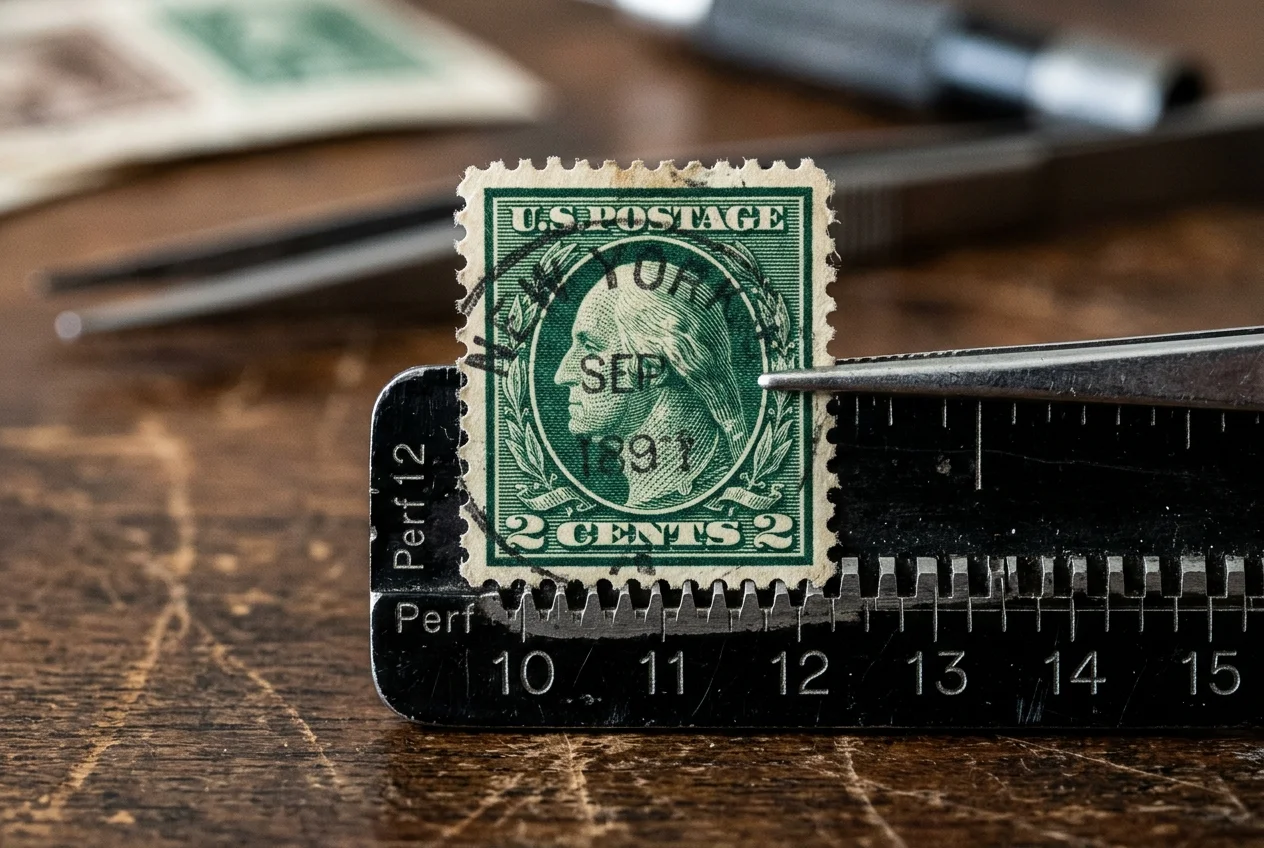
To measure your stamp, align its edges against a standard philatelic perforation gauge. You are looking for the exact number of holes within a two-centimeter span.
A standard mass-produced issue might measure Perf 11 on all sides, while a rare coil stamp—dispensed exclusively from automated vending machines—might only have perforations on the top and bottom.
Discovering a rare combination of Rotary Press printing with an unusual perforation gauge is the primary trigger for a massive price jump. A millimeter of difference in perforation spacing can literally mean the difference between pennies and thousands of dollars.
Common Mistakes When Finding the Scott Number
Every verified stamp variety receives a unique alphanumeric identifier known as a Scott number.
Published annually, the Scott Catalog serves as the definitive pricing and reference guide for collectors worldwide. A frequent mistake beginners make is visually matching their stamp to the first picture they see in the book and assuming they hold a high-value item.
Because the basic Washington profile design repeats across dozens of separate catalog entries, visual matching is practically useless.
You must confirm the exact perforation size, identify the specific printing type, and check for a watermark using specialized detection fluid before you can assign a definitive Scott number.
We see the exact same catalog confusion when people research Washington 3 cent stamp values. Skipping these rigorous verification steps always leads to false hope and incorrect valuations.
Mint Condition vs. Used: How Grading Affects Value
Even if you successfully identify a rare variety through perforation and watermark testing, physical condition dictates the final price ceiling.
A stamp in flawless mint condition will command a massive premium over a used copy of the exact same Scott number. Collectors demand absolute physical perfection when spending thousands of dollars at competitive auction houses.
The most valuable specimens still possess their original gum on the back and have never touched a piece of mail.
Furthermore, buyers look for perfect centering, meaning the printed design sits exactly in the middle of the paper margins without leaning toward any edge. A rare stamp with heavy post office cancellation marks, torn perforations, thinned paper, or faded color quickly drops to a fraction of its potential peak value.
Final Verdict: Keep Your Stamp or Sell It?
Unless you have definitively measured the perforations with a professional gauge and checked for watermarks using safe detection fluid, you should assume your stamp is a common variety.
If you enjoy the rich history behind the Washington-Franklin era, keep it as a fascinating piece of early 20th-century Americana. If you suspect you hold a genuine rarity based on strict physical measurements, invest in a magnifying glass before paying for a professional appraisal.
Frequently Asked Questions
Is a green 2 cent Washington stamp worth anything?
Most common green 2-cent Washington stamps are mass-produced and worth only pennies in used condition. However, rare versions with specific perforations, watermarks, or secret marks can have a high auction value. (Learn more about green George Washington stamp variations)
How do I know if my 2-cent stamp is rare?
To identify a rare version, you need to check the perforation measurement, look for a watermark, and examine the design for specific secret marks. Using a Scott catalog and a perforation gauge is essential.
Why do some 2 cent stamps sell for thousands?
High auction values are typically for pristine mint condition stamps with original gum, perfect centering, and specific rare printing errors or coil variations. The vast majority of surviving stamps do not meet these strict criteria.
What is the Washington-Franklin series?
The Washington-Franklin series is a complex set of US stamps issued between 1908 and 1922. They feature similar designs but have numerous engraving variations, making identification challenging for beginners.
Should I get my 2 cent stamp professionally appraised?
Only consider a professional appraisal if your stamp has been verified by an experienced philatelist to have rare perforations or secret marks. Otherwise, the cost of appraisal will exceed the value of a common stamp.
Get our latest guides, news, and insights highlighted in your Google Search & AI Overviews.