
✨ This article was AI edited. Editorial responsibility: Stampostage.info.
Produced with AI. This article was artificially generated. Editorial responsibility: Stampostage.info.
US classic stamps encompass the foundational postage stamp issues produced for the United States between 1847 and 1893—spanning the first federal 1847 Franklin and Washington issues, 1851–1860 imperforates, 1861 Civil War issues, 1867 grilled stamps, 1869 Pictorials, the Bank Note era, and concluding with the landmark 1893 Columbian Exposition issue.
The nineteenth century represents the undisputed golden era of American philately. During this foundational period of rapid postal expansion, industrial innovation, and civil conflict, postage stamps evolved from primitive hand-cut labels into sophisticated masterpieces of steel-plate intaglio line engraving. Produced by renowned private banknote printing firms under federal contract—including Rawdon, Wright, Hatch & Edson; Toppan, Carpenter & Co.; and the National, Continental, and American Bank Note Companies—classic US stamps embody the history, politics, and artistic triumphs of early America. Today, they form the premier blue-chip foundation of advanced stamp collecting worldwide.
Chronological Taxonomy of US Classic Stamps (1847–1893)
Philatelic historians divide nineteenth-century United States postage into distinct manufacturing and historical epochs:
| Classic Philatelic Era | Active Years | Primary Security Printers | Key Landmark Issues & Scott Numbers | Defining Production Characteristics |
|---|---|---|---|---|
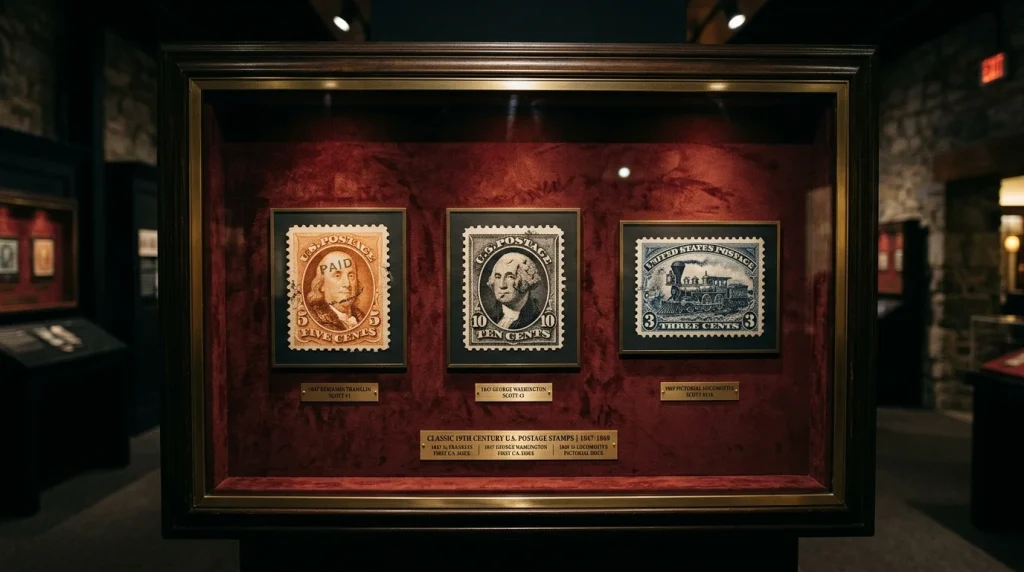
| The First Federal Issues | 1847–1851 | Rawdon, Wright, Hatch & Edson (New York) | 5¢ Franklin (Scott #1); 10¢ Washington (Scott #2) | Thin wove paper; imperforate; hand-cut with scissors; raw red-brown and black inks. |
| The 1851–1860 Imperforate & Perforated Series | 1851–1860 | Toppan, Carpenter, Casilear & Co. (Philadelphia) | 1¢ Franklin (Scott #5–9, 18–24); 3¢ Washington (Scott #10–11, 25–26); 12¢ Washington (Scott #17, 36) | Introduction of rotary perforating machines in 1857 (Perf 15); intricate ornamental frame variations and recut types. |
| The Civil War Issues & Demonetization | 1861–1866 | National Bank Note Company (New York) | 1861 “First Design” and regular issues (Scott #63–78); 1863 2¢ “Black Jack” (Scott #73); 1866 15¢ Lincoln (Scott #77) | Complete demonetization of pre-1861 stamps to invalidate Confederate postal stocks; first black mourning stamp (Lincoln). |
| The Grilled Stamp Issues | 1867–1871 | National Bank Note Company | Grill Types A through Z (Scott #79–144); 1¢ Z-Grill (Scott #85A – rarest US stamp) | Embossed waffle-like pyramidal impressions pressed into paper to break fibers and absorb cancel ink. |
| The 1869 Pictorial Issue | 1869–1870 | National Bank Note Company | 1869 Pictorials (Scott #112–122); Inverted Centers (Scott #119b, #120b, #121b) | America’s first square stamps, two-color printing, and non-presidential historical scenes (locomotives, ships, Columbus). |
| The Bank Note Era | 1870–1893 | National (1870–73), Continental (1873–79), American (1879–93) | Large and Small Bank Note issues (Scott #134–218) | Introduction of Continental “Secret Marks”; transition from hard wove to soft porous paper. |
| The Columbian Exposition Issue | 1893 | American Bank Note Company | Columbian Commemoratives 1¢ through $5 (Scott #230–245) | America’s first official commemorative series; large commemorative format; high dollar denominations. |
The 1847 Issues: The Dawn of Federal Postage
On July 1, 1847, the United States Post Office Department placed the nation’s first official federal postage stamps on sale in New York City. Prior to this date, mail was either sent unpaid (with postage collected from the recipient on delivery) or marked with local provisional stamps created by individual postmasters.
The issue consisted of two denominations engraved on steel plates:
- The 5-Cent Franklin (Scott #1): Depicting Benjamin Franklin (the first Postmaster General under the Continental Congress) from a drawing by James B. Longacre, printed in rich red-brown ink. It paid the uniform letter rate for travel under 300 miles.
- The 10-Cent Washington (Scott #2): Featuring George Washington from Gilbert Stuart’s famous portrait, printed in intense black ink. It paid the letter rate for distances exceeding 300 miles.
Because neither issue was perforated, surviving copies with four wide, untouched margins that display full white space around the engraved framelines are rare and fiercely contested at auction.
The 1867 Grilled Stamps and the Legendary 1¢ Z-Grill
During the 1860s, postal authorities grew concerned that dishonest citizens were chemically washing postmarks off used stamps to reuse them on mail. To prevent this revenue loss, inventor Charles F. Steel patented a mechanical embossing process known as “grilling.”
Before inking, sheets of paper were passed through a heavy roller studded with tiny pyramidal embossing points. This embossed a rectangular grid pattern into the paper fibers, breaking the paper’s surface tension so that ink cancellations would penetrate deeply into the weave, making washing impossible.
The BEP experimented with various grill sizes and point patterns, classified by philatelists with letters A through J and Z:
- The 1¢ Benjamin Franklin “Z-Grill” (Scott #85A): Features points with horizontal ridges rather than vertical ones. Only two copies are known to exist in the entire world. One copy resides permanently in the William H. Gross collection at the Smithsonian National Postal Museum; the second copy sold at auction in 2024 for an astonishing $4.36 million, cementing its status as the most valuable single United States postage stamp in existence.
The 1869 Pictorials and America’s First Color Inverts
In 1869, the Post Office broke with twenty-two years of tradition by issuing a bold, square-format series depicting historical scenes and modern industrial marvels rather than standard portrait busts of dead statesmen:
- 3¢ Locomotive (celebrating the completion of the Transcontinental Railroad).
- 11¢ Shield, Eagle, and Flags.
- 12¢ S.S. Adriatic (transatlantic steamship mail transit).
- 15¢ Landing of Columbus (first two-color printing).
- 24¢ Signing of the Declaration of Independence.
Because the 15¢, 24¢, and 30¢ stamps required two passes through the printing press (one pass for the colored frame, a second for the central pictorial vignette), printing pressmen inadvertently fed several sheets inverted. These 1869 Inverted Center Errors (Scott #119b, #120b, #121b) represent America’s first philatelic inverts, predating the famous 1918 Inverted Jenny by nearly half a century!
The Bank Note Era and Continental Secret Marks
Between 1870 and 1893, three successive private banknote companies printed the large definitive issues of the United States. When the Continental Bank Note Company took over the printing contract from the National Bank Note Company in 1873, they acquired the original printing plates. To differentiate their printings from National’s and account for royalties, Continental engravers cut tiny microscopic alterations—known as “Secret Marks”—into the transfer dies:
- 1¢ Franklin: A tiny crescent dash added inside the ball of the numeral “1” in the upper left scroll.
- 2¢ Jackson: A tiny crescent dot carved into the ribbon scroll below the letter “U”.
- 3¢ Washington: A subtle shading stroke added to the lower ribbon beneath the words “THREE CENTS”.
Using a 10x jeweler’s loupe to detect these secret marks allows collectors to distinguish between abundant Continental issues and high-value National printings.
The 1893 Columbian Issue: The Birth of the Commemorative
To celebrate the 400th anniversary of Christopher Columbus landing in the New World and promote the 1893 World’s Columbian Exposition in Chicago, the Post Office issued the nation’s first official commemorative set. Ranging from 1 cent to an unprecedented 5 dollars, the sixteen engraved pictorial stamps depicted the dramatic narrative of Columbus’s voyages.
Because few nineteenth-century Americans could afford to tie up $5.00 (equivalent to more than two weeks’ wages for an ordinary laborer) in commemorative postage, the high dollar values ($1 through $5, Scott #241–245) had exceptionally low print runs. Today, a pristine Mint Never Hinged set of 1893 Columbians remains the ultimate crown jewel of classic American collections, commanding between $15,000 and $35,000 depending on condition grade.
Frequently Asked Questions on US Classic Stamps
What is the difference between an imperforate and a perforated classic stamp?
Stamps printed between 1847 and mid-1857 were imperforate, meaning they had smooth edges and had to be cut from sheets by hand using scissors. Starting in 1857, the Post Office introduced perforating machines that punched lines of tiny round holes between stamps, allowing them to be torn apart easily. Imperforate copies require clear, wide margins around all four edges to achieve top collector values.
How can I verify if my classic 19th-century US stamp is authentic?
Due to the high values associated with classic US rarities, counterfeit cancellations, fake grills, altered perforations, and repaired thins exist in the marketplace. Any valuable classic stamp should be submitted to the Philatelic Foundation (PF) in New York or the American Philatelic Expertizing Service (APEX) for an official Certificate of Authenticity before buying or selling.
Why are stamps with “grills” so difficult to identify?
Over the decades, handling and moisture often flatten the embossed grill points back into the paper weave. Detecting faint grills requires placing the stamp face down on black paper under strong raking side lighting, or using watermark fluid to illuminate the broken paper fibers. Measuring the exact count of horizontal and vertical points is essential for determining the specific grill variety.
Get our latest guides, news, and insights highlighted in your Google Search & AI Overviews.