
✨ This article was AI edited. Editorial responsibility: Stampostage.info.
Produced with AI. This article was artificially generated. Editorial responsibility: Stampostage.info.
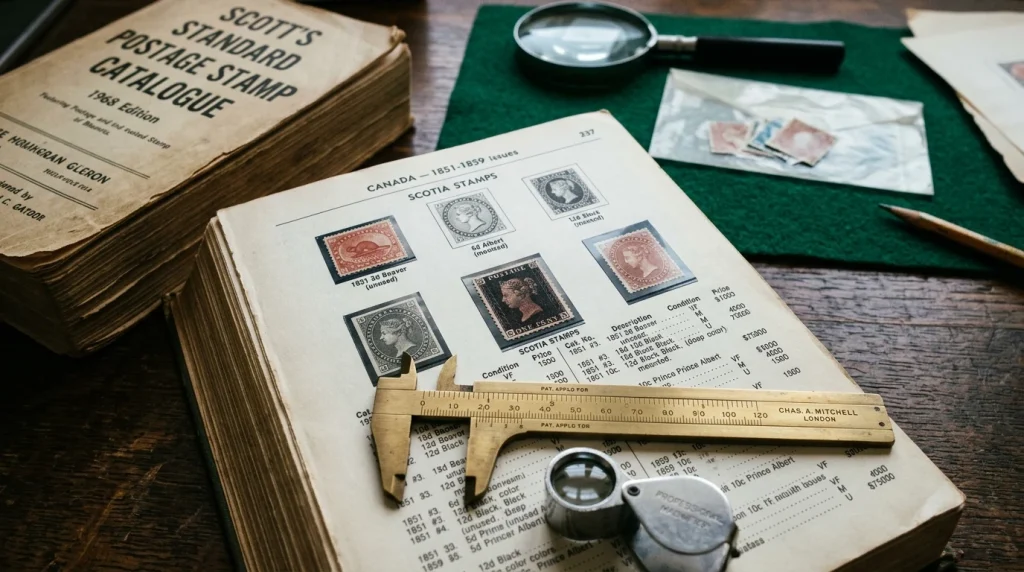
A stamp collectors price guide is a standardized philatelic valuation reference—such as the Scott Standard Postage Stamp Catalogue, Stanley Gibbons, or Michel—that establishes benchmark retail replacement values, historical auction realization trends, and condition-adjusted pricing metrics across postal issues worldwide.
Determining the fair market value of postage stamps is among the most misunderstood aspects of collecting. Heirs inheriting inherited albums, novice hobbyists, and veteran philatelists alike often struggle with the significant disparity between published catalog figures and actual cash realization at public auction or over dealer counters. A comprehensive stamp collectors price guide bridges this knowledge gap by explaining how condition grading, gum status, centering precision, paper varieties, and market liquidity interact to dictate real-world valuations.
The Premier Philatelic Catalog Systems
Valuation systems vary by geographical region and collector specialization. Professional dealers and auction houses rely on standardized, annually audited reference catalogs:
| Catalog Name | Primary Geographic Focus | Numbering & Identification System | Valuation Basis |
|---|---|---|---|
| Scott Standard Postage Stamp Catalogue | United States and Global Worldwide | Universally recognized Scott Numbers (e.g., Scott #1, #C3a). | Estimated retail selling price for a sound stamp in Very Fine (VF) condition. |
| Stanley Gibbons (SG) | Great Britain and British Commonwealth | SG Reference Numbers, extensively cataloging subtle watermark and watermark inverted varieties. | Retail price in British Pounds (£) for items sold in the Stanley Gibbons London Strand shop. |
| Michel (Schwaneberger Verlag) | Germany and Continental Europe | Michel Numbers (MiNr), renowned for micro-varieties, plate flaws, and perforation variations. | Continental European retail market valuations in Euros (€). |
| Yvert & Tellier | France and French Colonies / Francophone World | Yvert Numbers, standard across French and Mediterranean philately. | French market dealer retail benchmarks in Euros (€). |
Catalog Value vs. Realized Cash Market Value
The single most critical rule in stamp valuation is recognizing that Catalog Value (CV) is not cash value. Published catalog prices represent what a collector might expect to pay an established retail stamp dealer to purchase an individual sound specimen in Very Fine condition, factoring in dealer overhead, inventory holding costs, curation time, and retail packaging.
In the real-world wholesale and auction marketplace, transaction prices follow well-established market percentages:
- Common 20th-Century Material (1930–Present): Most commemoratives and definitives produced after 1930 were hoarded in massive quantities by millions of collectors. These typically realize only 10% to 20% of catalog value in bulk lots, or trade merely at 50% to 75% of face value as usable discount postage.
- Standard Sound 19th-Century & Classic Material: Authentic nineteenth-century issues in sound Very Fine (VF) condition typically realize between 25% and 40% of catalog value in private dealer transactions, and 30% to 50% at open auction.
- Investment-Grade High-Grade Rarities (Grades 95–100): Flawless gems certified in Superb or Gem condition often smash through catalog ceilings, realizing 200%, 500%, or even 1,000% of standard catalog value due to intense competition among registry set collectors.
The 4 Pillars of Stamp Pricing and Valuation
When an expertizes appraiser evaluates a collection, four physical variables determine where a stamp lands on the pricing spectrum:
1. Centering and Margin Geometry
Centering refers to the spatial alignment of the printed design relative to the perforated paper borders. Because early printing presses required manual sheet feeding, designs frequently printed off-center:
- Gem (100) / Superb (98): Flawless mathematical symmetry. Outer margins are expansive, razor-straight, and equidistant on all four sides.
- Extremely Fine (XF 90): Ample borders on every side; slight visual bias detectable only upon close inspection.
- Very Fine (VF 80): The baseline standard for catalog values. Design is comfortably balanced and completely clear of perforations.
- Fine (F 70): Design is heavily biased toward one side, with perforations touching or nearly clipping the outer frameline. Valuation drops by 60% to 80% below catalog value.
- Poor / Average (P/Avg): Perforations cut significantly into the printed design. Value drops to pocket change unless the issue is an extreme historic rarity.
2. Gum Condition (Mint vs. Used)
For unused postage stamps, the condition of the original adhesive gum on the reverse side dramatically affects pricing:
- Mint Never Hinged (MNH): The original gum is 100% pristine, unbroken, and free of any mark, glaze, or disturbance from stamp hinges. MNH specimens command the highest price multiples.
- Mint Lightly Hinged (MLH): The stamp has an original gum backing, but bears a minor, faint shadow from a peeled peelable glassine hinge. Valued at roughly 40% to 60% of MNH levels for 20th-century stamps.
- Mint Remummed (RG): A damaged or regummed stamp where counterfeit adhesive was reapplied to simulate mint status. Regummed stamps are considered severely altered and trade at heavy discounts.
- No Gum (Unused): The stamp is uncancelled, but the gum has been washed away (often done historically to prevent tropical humidity curling).
3. Physical Flaws and Faults
Any physical imperfection severely reduces marketability. Common flaws that trigger immediate price penalties include:
- Thins: A loss of paper fibers on the reverse, often caused by improperly ripping a stamp from a hinged album page. A thin generally reduces market value by 70% to 90%.
- Pulled or Short Perforations: Missing or torn perforation teeth along the outer border.
- Creases and Bends: Structural fractures in the paper weave caused by mishandling or folding.
- Foxing and Staining: Brown fungal oxidation spots or water damage stains on the paper matrix.
- Pinholes and Tears: Punctures or edge rips resulting from postal pins or aggressive envelope opening.
4. Provenance and Expertizing Certificates
For any stamp carrying a catalog value exceeding \$200, an official Certificate of Authenticity from an accredited expertizing committee—such as the Philatelic Foundation (PF), the Philatelic Stamp Experts (PSE), or the Royal Philatelic Society London (RPSL)—is mandatory to achieve full market pricing. Certificates verify that the stamp is genuine, note any secret repairs or added perforations, and assign an authoritative numerical condition grade.
Comparative Price Guide: Common vs. Rare US Issues
To illustrate how subtle technical differences influence value, examine these famous comparative benchmarks:
| Stamp Issue & Denomination | Common Variety (Catalog Value) | Rare Variety (Catalog Value) | Key Distinguishing Diagnostic Feature |
|---|---|---|---|
| 1851 1¢ Benjamin Franklin | Type V (Scott #24): \$35 used | Type I (Scott #5): \$85,000 used | Completeness of outer ornamental scrollwork and plinths at top and bottom margins. |
| 1869 15¢ Columbus Landing | Type I or II (Scott #118/119): \$250–\$800 | Inverted Center (Scott #129): \$250,000+ | Central engraved tableau of Columbus landing is printed upside down inside frame. |
| 1908 2¢ Washington Carmine | Flat Plate Perf 12 (Scott #332): \$1.50 | Coil Waste Perf 11 (Scott #596): \$150,000+ | Rotary press dimensions (19.25 × 22.5 mm) combined with Perf 11 gauge. |
| 1918 24¢ Curtiss Jenny Airmail | Normal (Scott #C3): \$60–\$120 | Inverted Jenny (Scott #C3a): \$1,500,000+ | Blue Curtiss JN-4 biplane printed upside down within red frame. |
| 1934 3¢ Byrd Antarctic Expedition | Imperforate Sheet (Scott #733): \$1.00 | Standard common issue; millions printed. | Mass-produced souvenir sheet printed for widespread collector hoarding. |
Step-by-Step Methodology to Value a Stamp Collection
If you have inherited or acquired a stamp collection, follow this structured four-step appraisal framework:
- Sort by Era and Completeness: Separate nineteenth-century classic stamps (pre-1900) from modern twentieth-century commemorative sheets. Albums featuring meticulously mounted nineteenth-century issues or specialized postal history covers are vastly more likely to contain commercial value than envelopes stuffed with loose post-1940 mint commemorative sheets.
- Inspect for Soundness: Use a high-magnification jeweler’s loupe (10x to 20x) and quality stamp tongs (never fingers) to examine specimens against a black background. Look for intact perforation tips, clean margins, and absence of hinge thins.
- Consult Current Specialized Price Guides: Check recent editions of the Scott Specialized Catalogue (available at public libraries) to establish catalog benchmarks. Cross-reference prospective discoveries against realized prices on completed auction databases such as Robert A. Siegel Auction Galleries, Kelleher Auctions, or Cherrystone.
- Engage an Accredited Appraiser: If the collection contains verified early classics or extensive certified material, seek an appraisal from an American Stamp Dealers Association (ASDA) or American Philatelic Society (APS) certified dealer. Ensure you clarify whether you seek an insurance replacement appraisal (retail) or an immediate cash offer (wholesale liquidation).
Frequently Asked Questions About Stamp Price Guides
Where can I find free stamp values online?
Free online databases include the Mystic Stamp Company catalog, the Swedish Tiger US identification guide, and completed sales listings on eBay (filter by “Sold Items” to observe actual realized transactions rather than speculative asking prices). For auction-grade rarities, the Siegel Auction Galleries Power Search archive provides historical auction realization records dating back decades.
Why are most twentieth-century stamps worth so little?
During the 1930s through the 1980s, stamp collecting was the world’s most popular hobby. Tens of millions of people saved full sheets, first day covers, and plate blocks in pristine condition, anticipating future appreciation. Because supply vastly exceeded subsequent collector demand, most post-1935 mint stamps can easily be acquired today for less than their original inflation-adjusted issue price.
What is a “Plate Block” and does it add value?
A plate block is a block of four or more attached stamps retaining the sheet selvage margin that displays the etched steel plate serial number. While early 19th- and early 20th-century plate blocks command substantial premiums over individual singles, modern plate blocks issued after 1940 are extremely common and generally trade at nominal face-value levels.
How does cancellation type affect used stamp values?
Modern machine wave cancels and heavy roller postmarks decrease value. In contrast, nineteenth-century hand-carved cork “fancy cancels”—depicting stars, shields, skulls, geometric rosettes, or animals—can turn an ordinary \$10 classic stamp into a coveted \$500 display piece, particularly when fully tied to the original commercial envelope cover.
Get our latest guides, news, and insights highlighted in your Google Search & AI Overviews.