
✨ This article was AI edited. Editorial responsibility: Stampostage.info.
Produced with AI. This article was artificially generated. Editorial responsibility: Stampostage.info.
A postal service guide to stamps is an authoritative breakdown of the postage stamp categories, face-value rate denominations, physical formats (sheets, coils, booklets), and official regulatory rules mandated by the United States Postal Service (USPS) under Title 39 of the Code of Federal Regulations and the Domestic Mail Manual (DMM) for domestic and international correspondence.
Understanding how the United States Postal Service structures its postage stamp inventory is essential for everyday mailers, small business operators, invitation designers, and collectors alike. Beyond basic first-class letters, modern postal operations encompass complex parcel dimensional criteria, non-machinable surcharges, specialized business reply mechanisms, and non-denominated rate guarantees. This guide provides a thorough operational analysis of all current USPS stamp classes, postage rate calculations, physical dispensing formats, and statutory usage regulations.
USPS Stamp Formats: Sheet, Coil, and Booklet Panes
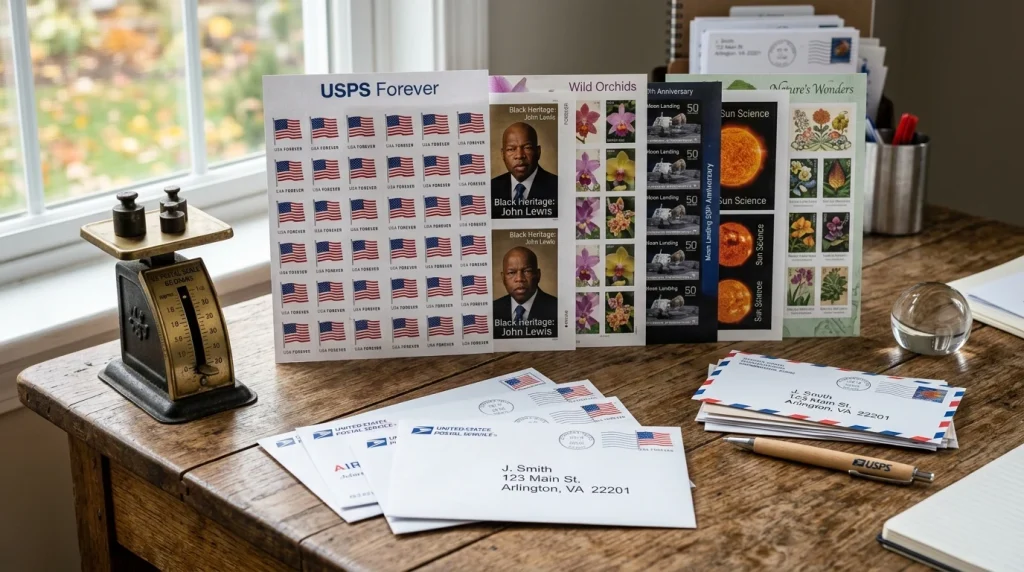
The Postal Service manufactures stamps in distinct configurations tailored to specific distribution channels, ranging from retail counter windows and self-service kiosks to automated commercial mailing machinery and home stationery drawers.
| Format Name | Standard Quantity | Primary Intended Use | Physical Distinguishing Characteristics |
|---|---|---|---|
| Sheet Panes | 20 stamps per pane | General retail consumer sales, commemorative collections, gift mailing. | Square or rectangular release liner backing; decorative selvage margins containing title banners, plate numbers, promotional text, and barcodes. |
| Coil Rolls | 100, 500, 3,000, or 10,000 stamps per roll | High-volume business mailers, continuous automated envelope feed applicators. | Continuous strip rolled around a central cardboard core; straight parallel cut top/bottom edges with side perforations. |
| Booklet Panes | 10 or 20 stamps per booklet | Portable home and pocket stationery usage; vending machine sales. | Foldable cardstock cover; compact peel-and-stick arrangement protected from moisture and purse abrasion. |
| Collector Souvenir Sheets | 1 to 12 stamps per sheet | Philatelic commemorations, international exhibitions, historical anniversaries. | Expansive thematic illustrative artwork extending across the borders; stamps often feature irregular die-cut shapes integrated into the wider graphic scene. |
Current USPS Stamp Classifications and Denominations
Postage stamps issued by the USPS are grouped into clear operational tiers that correspond directly to domestic mail classifications codified in the Domestic Mail Manual:
1. First-Class Mail Forever Stamps
The cornerstone of domestic letter mail, the First-Class Mail Forever stamp pays the full postage fee for a standard one-ounce commercial or personal letter. Since its statutory authorization in 2007, the Forever stamp carries no printed numerical dollar value. Its purchasing power is permanently locked to the prevailing First-Class 1-ounce letter rate: regardless of future postage price increases, a Forever stamp purchased years ago will always deliver a one-ounce First-Class letter without additional postage.
2. Additional Ounce Stamps
Standard First-Class letters may weigh up to 3.5 ounces before converting into large envelopes (flats). For each ounce or fraction of an ounce exceeding the first ounce, mailers must apply an “Additional Ounce” stamp. These stamps are also issued with Forever status—meaning an Additional Ounce Forever stamp will always cover the secondary ounce fee, regardless of future rate revisions.
3. Postcard Rate Stamps
The Postal Service maintains a dedicated lower tariff for standard rectangular postcards. To qualify for this rate without incurring full letter fees, the mailing piece must strictly satisfy physical USPS dimensional limits:
- Minimum Dimensions: 3.5 inches high by 5.0 inches long by 0.007 inches thick.
- Maximum Dimensions: 4.25 inches high by 6.0 inches long by 0.016 inches thick.
Any postcard exceeding 6.0 inches in length or 4.25 inches in height is legally classified as a letter and requires full First-Class letter postage.
4. Non-Machinable Surcharge Stamps
Certain envelopes cannot pass through high-speed automated facer-canceler and optical character reader (OCR) sorters without jamming or damaging the equipment. In these cases, the USPS levies a mandatory Non-Machinable Surcharge. The Postal Service issues distinct Non-Machinable Forever stamps (traditionally depicting colorful butterflies) that equal the sum of one First-Class ounce plus the non-machinable surcharge.
Characteristics that trigger the non-machinable surcharge include:
- Square-shaped envelopes (which have an aspect ratio less than 1.3).
- Envelopes with clasp closures, string ties, buttons, ribbons, or wax seals.
- Rigid mailpieces (envelopes containing stiff cardboard, wooden keys, or plastic cards that cannot bend around sorting drum rollers).
- Envelopes whose addressing is oriented parallel to the shorter dimension of the envelope.
5. Two-Ounce and Three-Ounce Rate Stamps
To eliminate the need for mailers to affix multiple clumsy stamps on formal stationery, the USPS issues dedicated two-ounce and three-ounce Forever stamps (frequently bearing elegant floral or celebration wedding designs). These are specifically engineered to accommodate heavy invitation suites, RSVP card inserts, RSVP return envelopes, and layered cardstock.
6. Semipostal (Fundraising) Stamps
Authorized by acts of Congress, semipostal stamps are sold at a premium above the regular First-Class postage rate. The differential surcharge between the retail purchase price and the standard postage value is remitted directly to designated federal causes and charitable research initiatives. Famous examples include the Breast Cancer Research semipostal, the Save Vanishing Species tiger stamp, and the Alzheimer’s Awareness issue.
USPS Letter Sizing and Physical Standards Matrix
Affixing the correct postage stamp requires checking the exact physical specifications of the envelope. The Domestic Mail Manual establishes strict geometric boundaries for standard First-Class envelopes:
| Mailpiece Parameter | Minimum Allowable Limit | Maximum Allowable Limit | Operational Penalty if Non-Compliant |
|---|---|---|---|
| Length (Longer Dimension) | 5.0 inches | 11.5 inches | Pieces under 5 inches are non-mailable; pieces over 11.5 inches reclassified as Flats. |
| Height (Shorter Dimension) | 3.5 inches | 6.125 inches | Pieces under 3.5 inches are non-mailable; pieces over 6.125 inches reclassified as Flats. |
| Thickness | 0.007 inches | 0.25 inches (1/4 inch) | Thickness over 0.25 inches reclassified as Flats or Parcels. |
| Total Weight | N/A | 3.5 ounces | Pieces exceeding 3.5 ounces reclassified as Large Envelopes (Flats). |
| Aspect Ratio (Length ÷ Height) | 1.3 | 2.5 | Ratios under 1.3 (e.g., square) or over 2.5 incur Non-Machinable Surcharge. |
How to Calculate Total Postage for Complex Mailings
Determining the correct stamp combinations for irregular letters involves three sequential calculations:
- Determine Base Letter vs. Flat Classification: Verify whether the envelope meets all standard letter dimensions (maximum 6.125″ × 11.5″ × 0.25″, and maximum 3.5 oz). If any single dimension exceeds these thresholds, the entire piece must be rated under Large Envelope (Flat) tariffs, which carry a higher base rate than standard letters.
- Calculate Total Weight Increments: Weigh the finished envelope with all enclosures, seals, and stamps attached using an accurate digital postal scale. Round up every fractional weight to the next whole ounce. For instance, an envelope weighing 1.1 ounces legally requires postage for two full ounces.
- Audit for Non-Machinable Characteristics: Inspect whether the envelope is square, rigid, contains loose objects, or features wax seals. If any condition exists, add one non-machinable surcharge unit to the final postage sum.
Official Postal Service Rules Regarding Stamp Affixing and Validity
The Domestic Mail Manual establishes binding postal regulations regarding how stamps must be affixed and when they remain legally valid:
Placement and Orientation
Postage stamps must be securely affixed in the upper right corner of the address side of the mailpiece. Placing stamps on the back flap, across envelope corners, or covering address text is prohibited. Optical facer-cancelers are programmed to locate, orient, and cancel stamps situated in this specific upper-right sector; mispositioned stamps result in processing delays or automated returns.
Can You Reuse Uncanceled Stamps?
Absolutely not. Under federal law (18 U.S.C. § 471 and § 1720), reusing or attempting to wash ink cancellations from a stamp that has already traveled through the mail constitutes a federal criminal offense. Even if a stamp passed through postal transit without receiving an ink cancel mark, once affixed and mailed, its statutory value is extinguished.
Do Old Denominated US Stamps Ever Expire?
With very few exceptions dating back to the American Civil War (when 1847 and 1851–1860 issues were demonetized in 1861 to prevent the Confederacy from financing military efforts with captured northern postal inventories), all regular and commemorative US postage stamps issued from 1861 to the present remain 100% valid for postal use at their printed face value. You may legally combine older 3¢, 5¢, 10¢, and 25¢ stamps together on modern envelopes until their collective face value matches or exceeds the current postal rate.
Frequently Asked Questions on Postal Service Stamp Regulations
How many stamps do I need for a 2-ounce envelope?
For a standard letter weighing between 1.01 and 2.0 ounces, you can affix either one dedicated Two-Ounce Forever stamp, OR one standard 1-Ounce Forever stamp plus one Additional Ounce Forever stamp. Alternatively, you can use two standard 1-Ounce Forever stamps, though this overpays the required postage since the second ounce fee is less than the base first-ounce rate.
Can I use domestic Forever stamps for international letters?
Yes. The USPS issues dedicated Global Forever stamps specifically designed to cover the 1-ounce international letter tariff to any country in the world. However, you can also use standard domestic Forever stamps for international postage: each domestic Forever stamp is credited at its current monetary First-Class purchase value toward the international rate.
What happens if a letter has insufficient postage?
If a letter is deposited with inadequate postage, postal handling depends on whether a return address is present. If a valid return address appears on the envelope, the USPS will return the mailpiece to the sender stamped “Returned for Additional Postage.” If no return address exists, the mailpiece is forwarded to the destination post office, where the postal carrier collects the deficit postage from the recipient as “Postage Due” prior to delivery.
Where can I purchase genuine USPS stamps at official face value?
Genuine stamps should be purchased directly from official USPS retail post offices, the official USPS.com online store, Automated Postal Centers (APCs), or authorized retail partners such as major supermarkets, banks, and pharmacies. Exercise extreme caution with online advertisements offering “discount Forever stamps” at 40% to 70% below face value; these are virtually always illegal counterfeit stamps imported from overseas that will be intercepted and confiscated by Postal Inspection Service automated detection units.
Get our latest guides, news, and insights highlighted in your Google Search & AI Overviews.