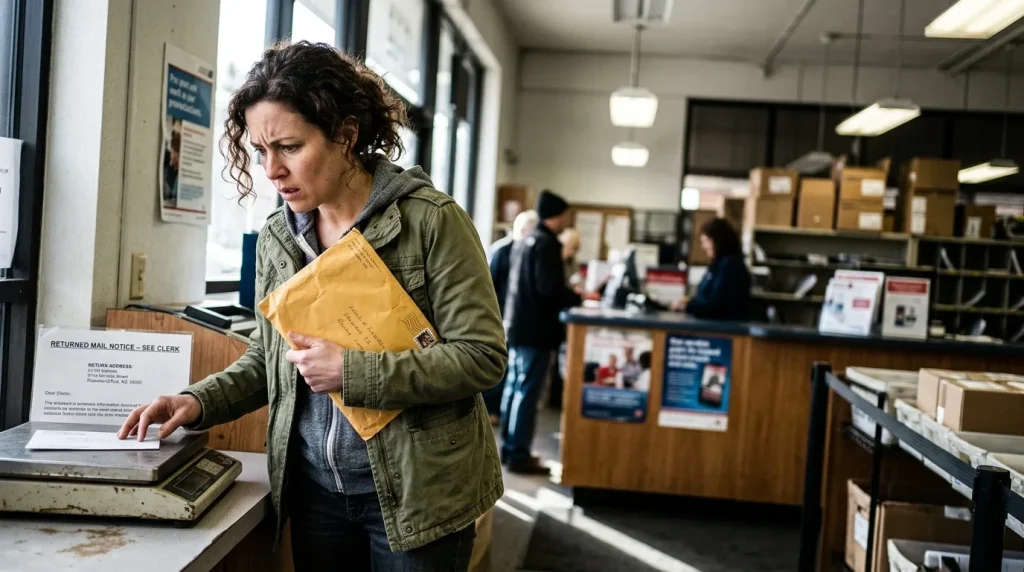

Finding the correct 1 oz large envelope postage requires understanding exact USPS rules before you drop your mail in the box.
A simple miscalculation during the upcoming July 2026 rate change can leave you paying penalty fees or dealing with undelivered mail.
We consistently see retail consumers and small business owners guess their postage costs and lose money on returned items.
You might think adding an extra stamp automatically solves the problem. But one hidden detail regarding the physical flexibility of your mail piece determines whether it arrives safely or gets hit with a massive penalty fee.
Finding the correct 1 oz large envelope postage requires understanding exact USPS rules before you drop your mail in the box. A simple miscalculation during the upcoming July 2026 rate change can leave you paying penalty fees or dealing with undelivered mail.
How Much is 1 Oz Large Envelope Postage Today?
The base postage rate for a 1 oz flat sent via First-Class Mail currently sits above the standard letter price.
You must attach the precise amount required for the first ounce to guarantee delivery without interruptions.
Postal prices fluctuate frequently, especially with the scheduled July 2026 increases targeting physical mail.
Senders who use metered mail machines often secure a slightly discounted postage rate compared to those buying physical stamps. Always verify the official pricing charts before sending large bulk mailings.
Paying exact postage prevents your important documents from bouncing back to your return address. We tested various mailing strategies and discovered that rounding up your ounces leads to hundreds of dollars in wasted postage annually.

What Exactly Qualifies as a Large Envelope (Flat)?
USPS officially classifies a large envelope as a “flat” based on strict physical boundaries. To qualify for flat pricing, your mail piece must be rectangular and exceed standard letter dimensions.
Specifically, Flats must exceed at least one of the following minimum Dimensions:
- More than 11.5 inches in length
- More than 6.125 inches in height
- More than 0.25 inches (1/4 inch thick)
However, your envelope cannot exceed the maximum limits for flats. The absolute maximum thickness allowed is 3/4 of an inch.
If your item is under 1/4 inch thick but still large in height or length, it safely remains a flat.
The USPS Rigidity Test: Is Your Envelope Flexible Enough?
Size alone does not guarantee your item qualifies for flat pricing. Your envelope must also pass the official USPS Rigidity Test.
This requirement dictates that the mail piece must bend easily without cracking, tearing, or permanently creasing the contents inside.
Postal workers test rigidity by hanging the envelope off the edge of a counter and applying light pressure. If it remains stiff like a wooden board, it automatically fails.
We recommend performing a similar test at home by draping your envelope over the edge of a table.
Rigid items immediately incur higher package rates. Inserting thick cardboard inserts to protect photos often causes the envelope to fail the rigidity requirement.
How Many Forever Stamps Do You Need for Exact Postage?
Most everyday senders use standard Forever stamps to cover their mailing costs. Because the large envelope rate exceeds the price of a single stamp, you will inevitably need more than one.
Two Forever Stamps typically cover the 1 oz flat rate, but you will slightly overpay the requirement.
To avoid wasting money, you should intimately understand the current value of a Forever stamp and combine it with smaller denomination stamps.
Calculating exact postage saves you significant cash over a busy year of mailing.
We advise buying specific “additional ounce” stamps or cent-denominated stamps to hit the exact required total.
Overpaying by a few cents seems harmless until you scale it across hundreds of outgoing client catalogs.
How to Measure and Weigh Your Mail Correctly
Never guess the weight or size of your outgoing mail. Use a calibrated digital kitchen scale to measure the exact ounces before applying any postage.
Even a fraction of an ounce over the limit pushes your envelope into the next pricing tier.
| Measurement Tool | Why You Need It |
|---|---|
| Digital Scale | Measures exact ounces accurately. |
| Rigid Ruler | Verifies length and height dimensions. |
| Cardboard Template | Quickly checks the 3/4-inch maximum thickness limit. |
Furthermore, your flat must maintain uniform thickness. Variations exceeding 1/4 inch across the surface of the envelope disqualify it from flat pricing.
Precision during the measuring phase prevents costly mailing mistakes.
What Triggers the Non-machinable Surcharge?
Sometimes a perfectly sized flat still incurs extra penalty fees. The dreaded Non-machinable Surcharge hits envelopes that automated sorting machines simply cannot process safely.
Items featuring metal clasps, external strings, or wax seals immediately trigger this costly penalty.
If you place a pen, a key, or a stack of coins inside, the envelope becomes lumpy and fails the automated processing requirements. Machines tear through uneven envelopes, ruining both the mail and the equipment.
We strongly advise reviewing the official non-machinable surcharge rules before sealing your envelope.
Removing metal clasps and taping the flap flat saves you from unnecessary processing fees.
First-Class Mail vs. Priority Mail for Flats
First-Class Mail remains the absolute cheapest option for standard flats weighing under 13 ounces.
It delivers reliably within a few business days but completely lacks detailed barcode tracking. You save money, but you sacrifice end-to-end visibility.
Upgrading to Priority Mail provides full tracking capabilities, insurance, and much faster delivery speeds.
If you are sending critical legal documents, signed contracts, or high-value catalogs, the higher price tag brings immediate peace of mind.
We recommend utilizing First-Class Mail for routine correspondence and reserving Priority Mail for time-sensitive, irreplaceable flats.
Choose the specific service that directly matches your delivery urgency.
Summary: Mailing Your Large Envelope Safely and Cheaply
Mastering the rules for a 1 oz large envelope actively protects your business budget. You must carefully balance the physical dimensions, ensure proper flexibility, and calculate the stamps precisely.
- Verify Dimensions: Ensure the item is rectangular and falls within flat parameters.
- Check Flexibility: Perform the table-edge bend test to confirm rigidity compliance.
- Weigh Accurately: Use a digital scale to confirm the exact weight.
- Calculate Stamps: Combine stamps to hit the exact price without overpaying.
Double-check your measurements before dropping anything into the blue collection box. Applying these strict mailing rules guarantees your flats arrive on time without surprise postage due notices for the recipient.
Frequently Asked Questions
How much postage do I need for a 1 oz large envelope?
A 1 oz large envelope (flat) sent via USPS First-Class Mail requires standard flat postage, which is subject to upcoming July 2026 rate increases. You must affix exact postage or use multiple stamps to ensure the envelope is fully covered before mailing.
How many Forever stamps are needed for a 1 oz large envelope?
You can generally use two Forever stamps to mail a 1 oz large envelope. Since each stamp covers a specific value, two stamps safely exceed the required rate for a standard 1 oz flat, though you will slightly overpay the exact postage. Read more about Forever stamps value.
What makes an envelope a flat according to USPS?
A large envelope or flat must be rectangular, flexible, and uniformly thick. It must exceed either 11.5 inches in length, 6.125 inches in height, or 0.25 inches in thickness to avoid being classified as a standard letter.
What happens if my large envelope is rigid?
If your 1 oz large envelope fails the USPS rigidity test or is too stiff to bend slightly, it will not qualify as a flat. It will be charged the higher package rate or a non-machinable surcharge depending on its exact dimensions. Read more about the non-machinable surcharge.
Does a 1 oz large envelope require a tracking number?
Standard USPS First-Class Mail large envelopes do not include tracking. If you need tracking for your 1 oz flat, you must upgrade to Priority Mail or use a specialized shipping service that includes barcode tracking.
Editorial Team
This article was prepared by our editorial team. We specialize in deep research and information processing to bring you the most useful answers.
Editorial Note: The content has undergone strict editorial control. Modern AI tools assist us in structuring and collecting data, but factual accuracy and final quality are always verified by a human.
Where to Buy Single Stamps and Mailing Supplies
If you only need to mail one letter, you might be wondering, where can you buy single stamps without having to purchase an entire booklet? The most reliable place is directly at the retail counter of your local Post Office. While many grocery stores sell postage, they usually only offer full books. Finding where to buy single stamps at retailers is sometimes possible at smaller convenience stores. Additionally, if you are preparing professional mailings, many of these centers also offer custom envelope printing services, allowing you to combine your postage needs with custom-branded envelopes in a single trip.
Get our latest guides, news, and insights highlighted in your Google Search & AI Overviews.