


Collectors constantly ask how to accurately show varieties in queen elizabeth stamps without confusing common damage for a rare fortune. If you have been sorting through albums of QEII issues, you already know the frustration. You spot what looks like a rare printing error, consult a Stanley Gibbons catalog, and realize it is just a damaged stamp worth mere pennies. The line between a worthless anomaly and a museum-grade treasure is incredibly thin. We tested dozens of appraisal methods and found that most collectors miss the highest-value errors simply because they look in the wrong places. But there is one specific flaw, hiding in plain sight on millions of stamps, that dictates whether your collection is worth face value—or enough to fund your retirement.
The true value in Queen Elizabeth stamps lies in understanding strict categories of production errors like watermark variations, missing colors, phosphor band shifts, and perforation mistakes. Identifying these genuine mint varieties requires UV lamps and specialized catalogs to distinguish them from mere post-office damage.
What Are the Most Valuable Methods to Show Varieties in Queen Elizabeth Stamps?
The true Queen Elizabeth stamps value lies in understanding the strict categories of production errors. You generally divide your focus between two major eras of QEII philately.
Wilding Series (1952-1967)
Features Dorothy Wilding’s portrait. Produced during a printing transition, leading to mechanical flaws, retouched areas, and watermark variations.
Machin Definitives (1967-Present)
Features Arnold Machin’s sculptured cast. Automated high-volume printing created errors like missing colors, missing gold heads, and phosphor band shifts.
The Wilding Series, featuring Dorothy Wilding’s portrait of the young Queen, circulated from 1952 to 1967 during a transition in printing technologies, leading to numerous mechanical flaws. Conversely, the Machin definitives, introduced in 1967 and featuring Arnold Machin’s sculptured cast, span decades of complex automated printing. The sheer volume of Machin print runs created a massive breeding ground for errors.
Valuable varieties occur when the printing process breaks down but the stamp passes quality control. A defect only holds a premium if it originated at the mint. Post-office damage or careless handling destroys value. We look for systemic errors—flaws repeated on specific positions of the printing cylinder—or spectacular breakdowns in ink application.
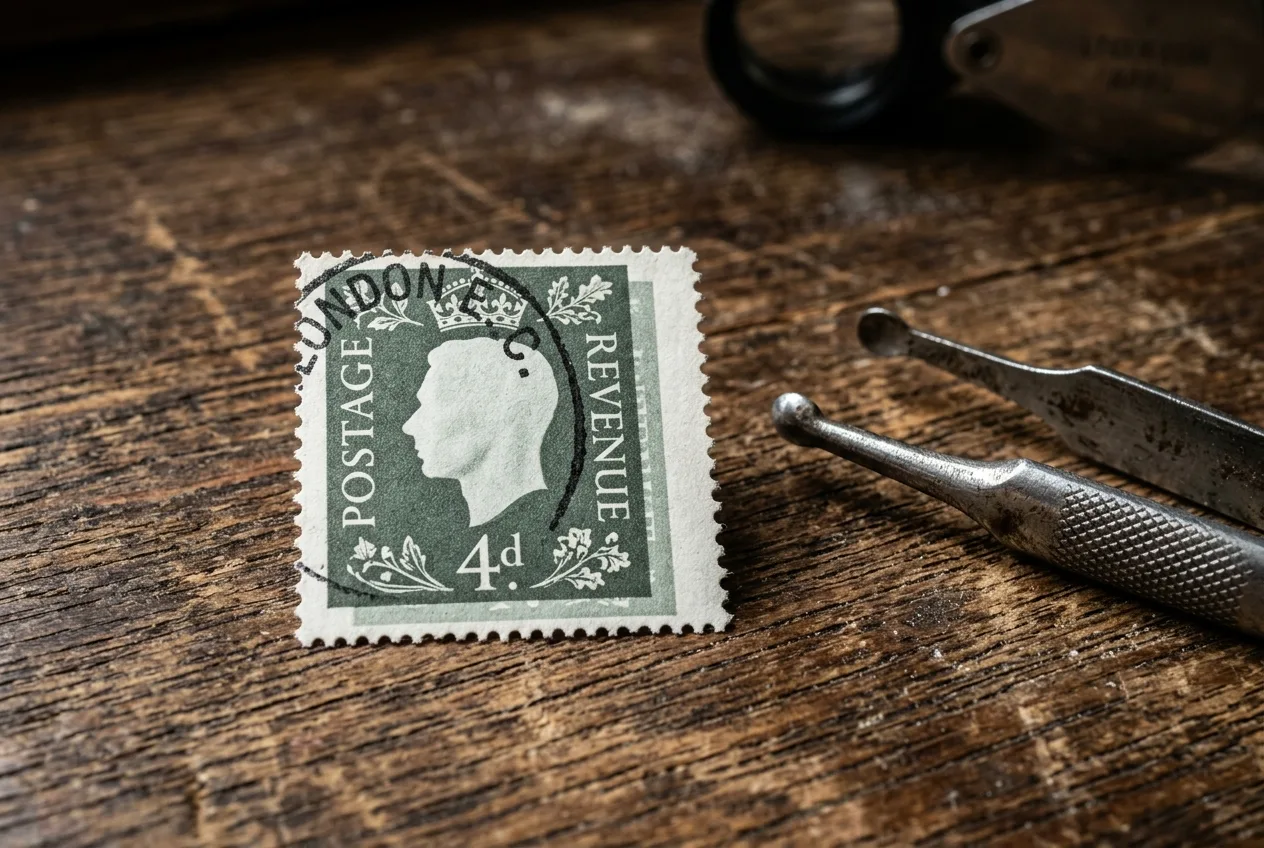
Identifying Wilding Series Varieties and Flaws
Early QEII issues require a sharp eye for subtle mechanical defects. During the production of the Wilding issues, printing cylinders frequently suffered minor damage. Instead of discarding the expensive cylinders, workers attempted to fix them, resulting in distinct retouched areas. These retouches appear as slightly darker or thickened lines in the background shading.
One of the most highly sought-after cylinder defects is the swan neck flaw. Found on the 2d value of the Wilding issues, this error manifests as a distinct white scratch curving down the Queen’s neck, resembling a swan. Collectors actively hunt for this specific plate flaw because it proves the stamp came from a faulty printing run before the cylinder was repaired.
Beyond surface defects, Watermark variations are critical for evaluating Wilding issues. The St. Edward’s Crown watermark can appear inverted, sideways, or completely missing. An inverted watermark on a seemingly common 3d Wilding multiplies its value exponentially.
Spotting Machin Definitives Printing Errors
The Machin series is a paradise for error hunters. When photogravure presses run low on a specific ink, or if a cylinder fails to engage properly, the result is a stamp with missing colors. A classic example is the 13p value where the brownish-red background is printed, but the overlay is absent.
Even more spectacular is the missing gold head error. Certain commemorative and high-value Machins utilize a secondary gold foil or ink layer. If the sheet skips the gold application stage, the stamp emerges with a blank silhouette. These are exceptionally rare and heavily counterfeited.
You will also encounter color shifts. This happens when the paper shifts slightly between different ink applications. The colors overlap incorrectly, creating a blurred or “ghosting” effect. Discovering genuine color shifts on first day cover stamps adds immense historical context and provenance, driving up the auction price.
How to Detect Phosphor Bands and Show Varieties in Queen Elizabeth Stamps
Many of the most lucrative QEII varieties are completely invisible under normal lighting. Royal Mail introduced Phosphor bands to the Wilding and Machin series to allow automated sorting machines to read the mail. These chemical bands were printed directly over the stamp face.
Sometimes, the phosphor applicator ran dry, or the bands were printed shifted to the left, right, or center instead of the standard layout. To detect these shifts, you need a shortwave ultraviolet (UV) lamp. Under the UV light, the Phosphor bands glow brightly. A stamp cataloged as having two bands that only shows one under UV light immediately jumps in rarity.
When evaluating full sheets, always check the margins for Cylinder numbers. Identifying a missing phosphor band on a stamp with an attached margin showing the cylinder number provides irrefutable proof of its origin.
Evaluating Physical Flaws: Imperforates and Mis-Perfed Stamps
Physical separation errors are highly visual and incredibly popular among investors. Imperforates occur when a sheet of stamps completely bypasses the perforating machine. Because unscrupulous dealers can simply cut the perforations off a standard stamp to fake an imperforate error, you should only buy or appraise imperforates in pairs or blocks to prove they were never punched.
Similarly, mis-perfed stamps happen when the paper sheet misaligns as the perforating pins strike. The holes punch directly through the Queen’s face or the text.
In extremely rare production setups, you might encounter Tête-bêche pairs, where one stamp is printed upside down in relation to the adjoining stamp. Discovering any layout inversion or severe perforation shift in modern QEII issues demands immediate expert certification.
Are 2026 Centenary Commemorative Stamps Worth Collecting?
With Royal Mail launching the April 2026 Centenary Commemorative Stamps to mark the 100th birthday of Queen Elizabeth II, collectors are actively questioning their future value. Modern printing facilities use laser-guided alignment, meaning the massive errors of the 1960s are virtually extinct.
You will not find heavy plate scratches or severe ink spills on these new issues. However, the massive volume of the Centenary print run guarantees that micro-varieties will escape the facility. We are seeing reports of slight phosphor shifts and microscopic die flaws on the first printings. Investors are storing full sheets specifically to hunt for these micro-errors once primary catalogers document known flaws.
The Most Common Myths About QEII Stamp Errors
The biggest trap for new philatelists is confusing post-office damage with a genuine mint error. A stamp that missed the ink roller will have a crisp, clean white space. A stamp that had its color scraped off by a sorting machine will show disturbed paper fibers under a loupe.
Another pervasive myth is that any misaligned printing equals wealth. Minor shifts of less than a millimeter are common printing tolerances. Only drastic shifts that severely alter the design command high prices.
Before assuming you hold a rarity, you need to properly organize your stamp collection by issue year, watermark, and cylinder. Comparing your suspect stamp directly against a known, normal copy from the exact same year is the only definitive way to verify if the anomaly is a true production variety.
Subscribe to Our Newsletter
Join our newsletter for the latest stamp investment tips and error discoveries!
Sign Up NowConclusion: Building Your Valuable QEII Stamp Collection
Hunting for varieties transforms basic collecting into an investigative pursuit. From mechanical flaws of the early Wilding issues to chemical phosphor variations of the Machins, the errors are out there waiting to be found. Equip yourself with a strong UV lamp, a precision magnifier, and an updated catalog. The difference between a standard definitive and a highly valuable error is often invisible to the naked eye.
Frequently Asked Questions
How can I show varieties in Queen Elizabeth stamps effectively?
To effectively show varieties in Queen Elizabeth stamps, use a strong magnifying glass and UV light to reveal phosphor bands and watermark variations. Organizing them by cylinder numbers and specific errors like color shifts helps showcase their unique value.
What is the swan neck flaw on QEII stamps?
The swan neck flaw is a well-known plate scratch found on early Wilding Series definitives. It appears as a white line resembling a swan’s neck, making it a highly sought-after variety among collectors.
Are Machin definitives with missing colors valuable?
Yes, Machin definitives featuring genuine missing colors, such as a missing gold head, are exceptionally rare and valuable. They occur due to misaligned printing or ink depletion during production.
How do you detect phosphor bands on British stamps?
Phosphor bands on British stamps are often invisible to the naked eye. You must use a specialized shortwave or longwave ultraviolet (UV) lamp in a dark room to make the bands fluoresce clearly.
Will the 2026 Centenary Commemorative Stamps have valuable errors?
While modern printing technology reduces mistakes, the massive production of the 2026 Centenary Commemorative Stamps means some mis-perfed or color-shifted varieties could still slip through and become valuable over time.
Get our latest guides, news, and insights highlighted in your Google Search & AI Overviews.