


You most likely have a stamp two cents united states postage red oval in an inherited collection. It usually carries a value of just a few pennies.
We see countless beginners struggle to identify these stamps because experts use confusing jargon.
You might flip through an old album and wonder if you struck gold. Most of these red George Washington stamps printed in the early 1900s are incredibly common.
People mailed billions of letters during this era. You will find them in almost every vintage box of paper collectibles.
One tiny, invisible detail separates a worthless piece of paper from a $35,000 auction sensation. We know exactly where you need to look.
What Is the Value of a Stamp Two Cents United States Postage Red Oval?
A standard red George Washington stamp from 1910 typically sells for about twenty cents. Billions of these stamps flooded the mail system a century ago.
You can buy entire sheets of the common variations for under ten dollars.
However, a flawless specimen in mint condition (a stamp that has never been used) changes the equation entirely.
Collectors pay massive premiums for pristine copies possessing their original gum (the undisturbed adhesive on the back). They scrutinize the centering of the design fiercely.
We track market data daily to spot pricing trends. An exceptional rarity can achieve a staggering auction realization of tens of thousands of dollars.
You just need to know exactly which variation you hold in your tweezers.
The History Behind the 2-Cent Red Washington-Franklin Issues
The United States Postal Service produced the Washington-Franklin Issues between 1908 and 1922. They created these stamps to standardize postage designs across the entire nation.
Artists focused heavily on classical profiles of Washington and Franklin.
The government colored them red to comply strictly with the Universal Postal Union (UPU) mandate of 1898.
The UPU required all member nations to print domestic letter-rate stamps in red ink. This color-coding system helped postal workers sort international mail rapidly.
Printers experimented heavily with ink mixtures over those fourteen years. These experiments resulted in subtle color variations like carmine, rose, and red-brown.
You must examine your stamp under bright, natural daylight to spot these specific shade differences accurately.
Flat Plate vs. Rotary Press Coil: Production Methods Explained
Understanding how printers made your stamp unlocks its true value instantly.
The earliest versions used a flat plate method, pressing paper against a flat engraved metal sheet. This technique produced stamps with slightly rougher details and thicker ink lines.
Later, printers adopted the rotary press coil technique to speed up production. This process involved wrapping curved printing plates around a continuous metal cylinder.
The curved plates actually stretched the stamp design slightly longer or wider.
The American Philatelic Society considers this dimensional difference a crucial identifying factor. Experts measure the design to the fraction of a millimeter to verify authenticity.
If you want to master this skill, you must learn to identify Washington variations accurately.
Step 1: Check the Perforations on Your 2-Cent Red Stamp
You must measure the perforations (the small holes separating the stamps) to find rare varieties.
Printers changed these perforation measurements multiple times during the long production run. Some stamps feature holes on all four sides, while coil stamps have flat edges.
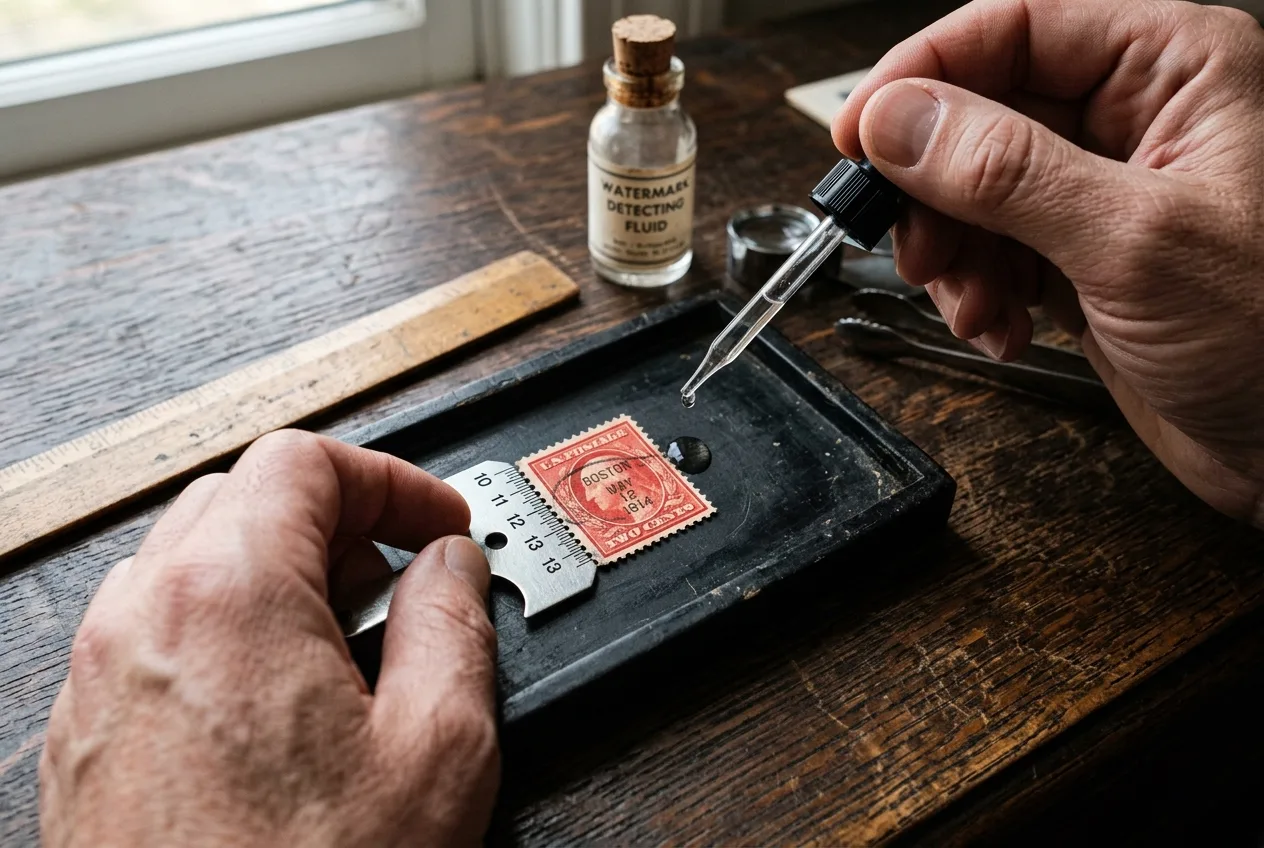
You need a specialized tool called a perforation gauge to measure them properly. Place your stamp against the gauge and match the holes to the printed dots.
Slide the stamp up or down until the holes align perfectly with the pattern.
A standard stamp might have 11 holes per two centimeters. A rare error might feature exactly 10 holes horizontally.
Sometimes, production skipped the hole-punching step entirely, creating highly valuable imperforate variations.
Step 2: The 60-Second Watermark Test
Your stamp might hide a secret pattern pressed directly into the paper fibers. We call these hidden patterns watermarks, and they prevent counterfeiting.
You cannot see them easily with the naked eye under normal room lighting.
You must place your stamp face down in a black plastic tray. Then, apply a few drops of specialized watermark fluid directly onto the paper.
A single or double-line “USPS” pattern will magically appear on the back.
Never use regular water, as it will destroy the valuable original gum. Always use professional, fast-evaporating philatelic fluids.
If you need help with this process, read our complete guide on detecting stamp watermarks safely.
Step 3: Finding Rare Errors and Scott Catalog Numbers
You can now cross-reference your specific measurements with a standard reference guide.
Every stamp variation has a unique Scott catalog number (the official identification code used by collectors).
Matching your exact perforations and watermarks to this catalog reveals your stamp’s true identity.
Sometimes, the printing presses malfunctioned during complex production runs. These mistakes created highly sought-after rare printing errors.
Collectors actively hunt for specific catalog numbers like Scott 594 or Scott 596.
If you suspect you found one of these legendary errors, you need expert verification. The Philatelic Foundation can officially authenticate your discovery with a certified document.
This certificate guarantees the value of your stamp before you sell it.
Common Myths About 2-Cent Red Washington Stamps
Many beginners mistakenly believe that extreme age automatically equals immense wealth. A stamp from 1910 is undeniably old, but printers made billions of them.
Rarity dictates value entirely, regardless of how many decades have passed.
Another popular myth suggests that cancelled stamps hold absolutely zero value. While unused copies generally fetch higher prices, specific rare cancellations actually increase a stamp’s worth.
Collectors prize unusual postmarks, colored ink cancels, or specific historical city marks.
Do not discard a stamp just because it looks slightly faded or worn. We always recommend analyzing the physical traits systematically before making any assumptions.
A dirty stamp might still possess the rare perforation combination you want.
Final Thoughts: Getting Your Stamp Appraised
You now possess the tools to evaluate your red George Washington stamp confidently.
Check the perforations first, test for watermarks safely, and consult the catalog carefully.
Always handle your stamps with professional metal tongs to avoid transferring skin oils.
Do not rush to throw away any damaged or strange-looking copies. They might hold hidden secrets that you missed on the first pass.
We suggest organizing them by color shade to make the process easier.
Ready to identify more of your collection? Check out our complete George Washington Stamp Identification Guide to uncover more hidden rarities.
Frequently Asked Questions
Is my 2-cent red George Washington stamp rare?
Most 2-cent red George Washington stamps are very common and worth only a few cents. However, a small number of rare errors, such as specific imperforate variations or rare watermarks, can be extremely valuable and worth thousands of dollars to serious collectors. Learn more about rare printing errors.
How do I check the watermark on a 2-cent red stamp?
To safely check the watermark on a 2-cent red stamp, place it face down in a watermark tray and apply a few drops of watermark fluid. Look for either a single-line or double-line ‘USPS’ lettering pattern to help identify the stamp’s specific issue. For details see detecting stamp watermarks.
What is the difference between flat plate and rotary press coil stamps?
Flat plate stamps were printed on flat metal plates, resulting in slightly different dimensions and a rougher feel. Rotary press coil stamps were printed on curved plates in a continuous roll, which stretched the design slightly. Identifying this difference is key to finding rare varieties.
Where can I get an accurate auction realization for my stamp?
You can find accurate auction realizations by checking recent sales data from reputable auction houses, searching the Philatelic Foundation database, or consulting the latest Scott catalog numbers for your specific stamp variant.
Why is the 2-cent Washington stamp colored red?
The 2-cent Washington stamp is colored red to comply with the 1898 Universal Postal Union (UPU) mandate. The UPU required all member nations to use red ink for domestic letter-rate postage stamps to standardize international mail sorting.
Get our latest guides, news, and insights highlighted in your Google Search & AI Overviews.