The true value of rare german stamps is determined by their historical era, printing volume, and precise physical condition. While millions of standard postage issues exist, a recent surge in high-value auction results proves that specific Old Germany states and specific printing errors are breaking price records in 2026.
If you recently inherited a collection, you might assume your albums hold a fortune, but the reality of the philatelic market is highly specific.
Most beginner collectors struggle to navigate academic resources to identify these hidden gems. However, one specific detail completely alters a stamp’s value from a few cents to thousands of dollars, and most people overlook it entirely…
What Makes Rare German Stamps So Valuable in 2026?
Collector demand has drastically shifted toward early European issues, driving up auction prices for well-preserved specimens.
The fascination stems from the sheer complexity of Germany’s postal history before unification. Collectors aggressively hunt for pristine issues from independent regions like Bavaria, which issued some of the very first regional postage.
Scarcity drives this market, as survival rates for paper goods from the 1850s remain incredibly low. Natural degradation, two world wars, and improper storage have destroyed the vast majority of original printings.
If you want to understand the exact market trajectory and current valuations, our 2026 stamp price guide provides concrete data.
The Golden Era: Old German States and the Germania Series
Before a unified postal system existed, individual territories like Württemberg, Heligoland, Bergedorf, and Lübeck produced their own distinct postage.
These Old German States issues represent the crown jewels of European philately. The printing runs were small, and the survival rate is marginal.
Transitioning into the early 1900s, the Germania Series became the definitive stamp of the empire, replacing the earlier issues depicting Kaiser Wilhelm II.
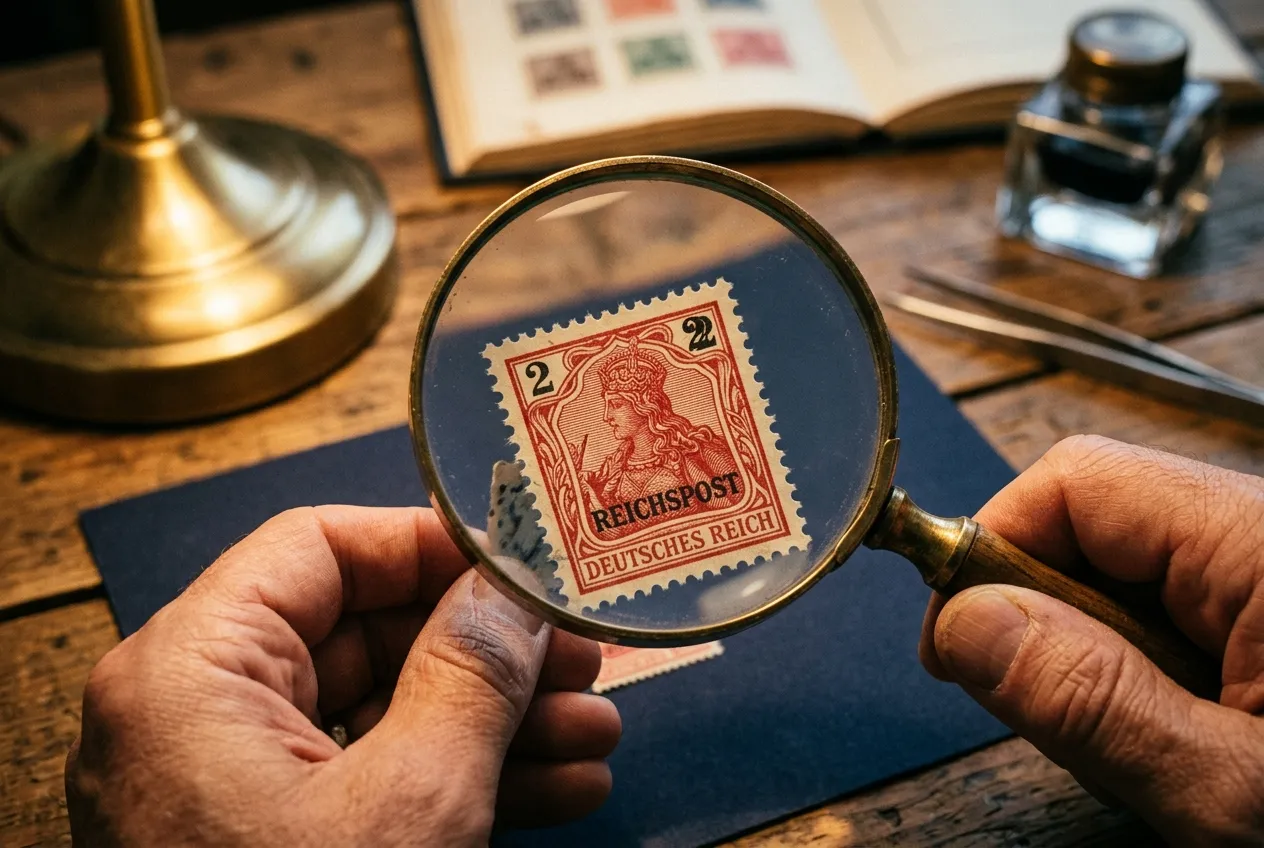
While standard Germania stamps are common, specific shades, perforations, and watermarks from this series command massive premiums at auction today. The transition period from individual state issues to a unified national postal system created numerous short-lived provisional stamps that are now fiercely contested by top collectors.
Spotting the Details: Watermarks, Overprints, and Printing Errors
A stamp’s design is only the surface layer of its valuation. Serious collectors use specialized tools to examine watermarks and precise perforations.
A perfect example is the 2-mark quatrefoil watermark, a specific paper variation that drastically multiplies a stamp’s worth.
Similarly, printing errors and emergency issues like the famous Vineta Provisionals (a bisected stamp created on a cruiser) hold legendary status.
Furthermore, an intact layer of original gum on the back of the stamp is mandatory for top-tier valuations. Even a slight hinge mark or a tiny trace of moisture damage can cut the price in half.
Proper assessment requires high-resolution scanning and UV light inspection.
How to Authenticate Your Collection: BPP Certification & The Michel Catalogue
Because high-value rarities attract forgeries, raw uncertified stamps rarely achieve their full market potential. You need absolute proof of authenticity.
The European standard for this is BPP certification. Expert examiners thoroughly inspect the paper, ink, and perforations to issue a binding certificate of authenticity.
To identify your holdings before seeking certification, you must consult the Michel catalogue. This reference book is the definitive authority on German philately.
It documents every known variety, color shade, and printing anomaly, providing a standardized numbering system that international auction houses rely on for precise identification.
Step-by-Step Guide to Selling Your Stamps to an Expert Appraiser
- Do not clean or flatten: Attempting to remove hinges from your stamps yourself destroys value instantly. Improper handling is catastrophic.
- Organize chronologically: Use archival-quality stock books that protect the paper from humidity.
- Isolate potential rarities: Separate the items you suspect have high value based on your catalogue research.
- Contact a recognized expert: Find an appraiser who specializes in European philately.
They will assess the physical state of your collection and provide a realistic auction estimate, protecting you from lowball offers. An objective appraisal is your best defense against predatory dealers looking to buy rare items at bulk prices.
The Market for Third Reich and Weimar Republic Era Rarities
The hyperinflation period and subsequent regimes produced billions of stamps, making most of them practically worthless.
However, the Weimar Republic and Third Reich eras do contain specific, highly sought-after varieties. Genuinely rare overprints and unissued designs from these periods command significant attention from specialized collectors.
Certain propaganda issues and occupation stamps were printed in extremely limited batches.
To understand the broader context of these specific issues, exploring the history of Deutsches Reich stamps reveals exactly which variations hold true monetary value and which are mere historical curiosities.
Common Myths About German Empire Stamp Valuations
Many people assume that any stamp bearing the Imperial eagle or a swastika is automatically valuable. This is the biggest misconception in the hobby.
The vast majority of German Empire postage was mass-produced in staggering quantities. Age does not equal rarity.
Millions of these stamps sit in albums worldwide, holding almost zero monetary value. Just as many collectors mistakenly believe all Cold War era stamps are worthless, yet specific DDR rarities prove otherwise.
Valuation always comes down to verified scarcity, specific plate flaws, and impeccable preservation, not just the historical date printed on the paper.
Final Thoughts on Investing in Rare German Philately
Building a valuable portfolio requires meticulous research, expert authentication, and a deep understanding of historical printing practices.
If you hold a single flawless specimen from Bavaria or a complete set of certified Germania errors, the market continues to reward quality and rarity.
Protect your assets, consult the right references, and never underestimate the financial difference a tiny watermark can make. As historical documents and tangible assets, these small pieces of paper offer a fascinating glimpse into a turbulent past, while simultaneously serving as high-yield alternative investments for those who know exactly what to look for.
Frequently Asked Questions
What are the most valuable Old German States stamps?
The most valuable Old German States stamps come from Bavaria, Württemberg, and Heligoland. Early issues, especially those in mint condition with original gum, can fetch high auction prices. Rarity is determined by low printing volumes and survival rates over the centuries. For detailed valuations, see our stamp price guide.
How can I tell if my German stamps are rare?
To determine if your German stamps are rare, you must examine watermarks, perforations, and overprints. Use a magnifying glass to spot printing errors like the 2-mark quatrefoil watermark. Consulting the Michel catalogue and seeking BPP certification are essential for verifying true rarities.
Are Third Reich and Weimar Republic stamps worth money?
While millions were printed, specific Third Reich and Weimar Republic stamps are worth money if they possess unique printing errors or rare overprints. Mint condition examples with intact original gum and expert appraiser authentication are highly sought after by serious philatelists. Learn more about Deutsches Reich stamps.
What is the Michel catalogue for German stamps?
The Michel catalogue is the standard reference guide used by collectors and dealers worldwide to identify and value German stamps. It provides comprehensive listings of all issues, including minor varieties, watermarks, and errors, ensuring accurate market pricing for rare specimens.
Why is BPP certification important for rare German stamps?
BPP certification is crucial for rare German stamps because it guarantees authenticity and accurate grading by recognized experts. Given the high prevalence of forgeries, especially among high-value Old German States issues, a BPP certificate significantly increases a stamp’s market value and buyer confidence.
Error: Contact form not found.
Get our latest guides, news, and insights highlighted in your Google Search & AI Overviews.