

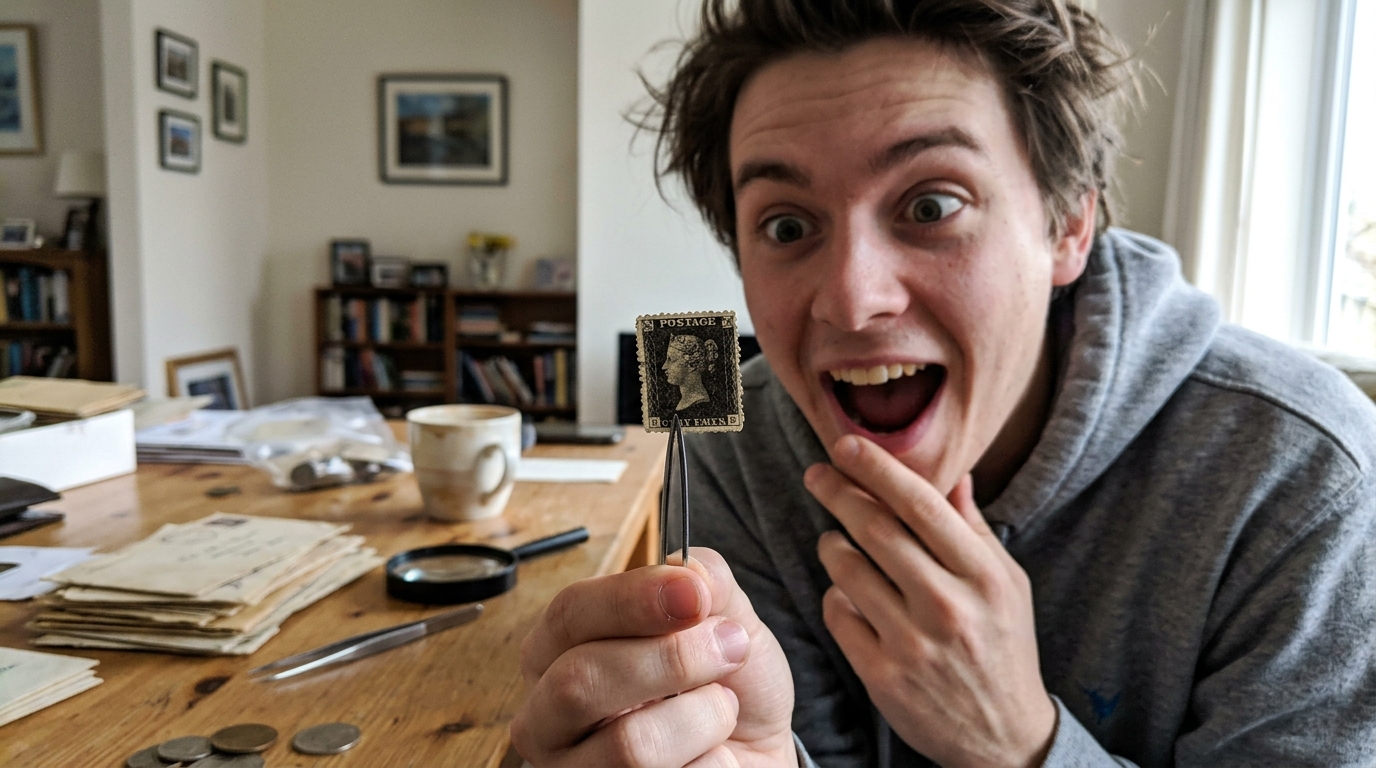
What exactly makes million dollar stamps rare pieces of history worth more per ounce than flawless diamonds?
The valuations in modern philately stem from extreme scarcity, pristine condition, documented provenance, and spectacular printing errors.
While the broader collectibles market sees peaks and valleys, the top tier of historical stamps continues to break records at elite auction houses.
High-net-worth investors are increasingly recognizing these tiny scraps of paper as unparalleled stores of wealth.
We recently investigated a private transaction involving a legendary 19th-century piece, bypassing public auctions entirely. The buyer wasn’t just acquiring an antique; they were securing a physical bearer asset with an unbroken chain of custody.
But during our research, we uncovered a microscopic anomaly in how these assets are evaluated today—a detail that completely changes the rules of the game.
What Makes Million Dollar Stamps Rare?
The leap from a valuable collectible to an eight-figure masterpiece requires unique circumstances. First, the survival rate is critical.
Most stamps were used, discarded, and destroyed. A million-dollar stamp is often one of fewer than ten known copies.
Second, printing errors generate massive premiums. When a 19th-century postal clerk loaded paper upside down, they accidentally minted future fortunes.
These anomalies form the bedrock of investment grade philately. Finally, provenance acts as an invisible multiplier.
If a stamp was owned by a legendary collector or royalty, its premium skyrockets. Every time it changes hands at elite auction houses, the documentation adds to its verifiable authenticity.
Without ironclad provenance, even the rarest item will struggle to reach its maximum financial potential on the open market.

The Holy Grails: Most Valuable Stamps in Philatelic History
The absolute zenith of this market features a few legendary names. The 1856 British Guiana 1c Magenta is essentially the Mona Lisa of stamps.
As the only known copy, its dark provenance—including time locked away by convicted murderer John DuPont—amplified its mystique before it sold for nearly $9.5 million.
In Europe, the Treskilling Yellow represents a famous printing error. Intended to be green, this Swedish stamp was accidentally printed in yellow, resulting in a unique survivor that repeatedly breaks auction records.
The Inverted Jenny is the gold standard for visual errors, featuring a biplane printed upside down.
If you want to dive deeper into the most valuable United States stamps, you must understand the Benjamin Franklin Z Grill.
This extremely rare grill pattern was pressed into paper to prevent ink from being reused. Only two copies exist.
Finally, the Sicilian Error of Color reminds us that regional postal mistakes can command extraordinary sums globally.
How Condition and Centering Impact Investment Grade Values
Scarcity is the baseline, but physical condition dictates the final financial outcome. In high-end philately, a millimeter of paper can represent hundreds of thousands of dollars.
Centering is arguably the most brutal metric. It refers to the exact alignment of the printed design relative to the edges.
A perfectly centered stamp commands a massive premium over one where the design touches the margin.
When you assess rare US stamps value, you must also evaluate the preservation of original gum, the sharpness of perforations, and the vibrancy of the ink.
Environmental damage, such as UV fading or thinning paper fibers, instantly disqualifies a stamp from the million-dollar tier.
Investors must maintain these assets in climate-controlled, archival environments to protect their investment grade status and prevent microscopic deterioration.
How to Authenticate Rare Stamps and Find a Certified Appraiser
Authenticity is the single most critical factor in alternative asset investing. The stamp market has battled sophisticated forgeries for over a century.
You cannot rely on a standard magnifying glass. You must engage a certified appraiser who utilizes forensic technology.
Modern authentication involves spectral analysis to date the ink and high-resolution scanning to verify the paper’s fiber structure.
For instance, if you need to identify Z Grill stamps, the appraiser measures the exact dimensions and depth of the grid impressions to ensure they match authentic 1860s templates.
Always demand a recent certificate of authenticity from recognized institutions like the Philatelic Foundation. A certificate from forty years ago is no longer sufficient.
Navigating Auction Houses and Reputable Stamp Dealers
Acquiring million-dollar assets requires operating in highly specialized circles. Elite institutions like Sotheby’s frequently host the most significant public sales.
They provide rigorous vetting, detailed provenance histories, and a transparent bidding environment. Bidding at this level involves competing against sovereign wealth funds and ultra-high-net-worth individuals.
However, many of the best pieces never reach the public market. Establishing a relationship with a reputable stamp dealer grants you access to private treaty sales.
A dealer acts as your broker, leveraging their global network to quietly source specific rarities for your portfolio. Look for decades of verifiable history and membership in international trade organizations.
They will guide you through the nuances of acquisition, ensuring you pay a fair market premium based on current macroeconomic trends in the collectibles sector.
Rare Stamps vs. Other Alternative Assets
Investors constantly seek uncorrelated assets to diversify their portfolios. While fine art, vintage cars, and rare wine dominate headlines, high-end stamps offer distinct logistical and financial advantages.
A multi-million-dollar stamp collection fits inside a single bank safety deposit box. It does not require a specialized garage, expensive maintenance, or climate-controlled wine cellars.
Furthermore, the top tier of the philatelic market exhibits remarkable resilience. When traditional equities or mid-tier collectibles suffer during economic downturns, trophy stamps hold their value.
The buyer pool consists of individuals whose wealth insulates them from standard economic shocks. This creates a highly stable, albeit illiquid, market environment.
Unlike digital assets, a rare stamp is a tangible piece of history. It offers a secure, physical store of wealth that is universally recognized by the global financial elite.
Common Misconceptions About Color Errors and Covers
New investors frequently misinterpret market signals, leading to expensive mistakes. The most pervasive myth is that any printing anomaly is highly valuable.
While legitimate color errors drive prices into the millions, minor ink smudges, poor inking, or later chemical alterations are worthless. An error must be documented, dramatic, and verified by an expert committee.
Another area of confusion surrounds the historical cover, an envelope with the stamp affixed and postmarked. Pieces like the Mauritius Ball Cover are legendary because they combine extreme stamp rarity with pivotal postal history.
However, an ordinary 19th-century cover is not inherently valuable. The value of a cover depends entirely on the specific rate markings, the routing history, and the historical significance of the sender or recipient.
Conclusion: Are Million Dollar Stamps Rare Enough for Your Portfolio?
Investing in the million-dollar tier of philately is not for the faint of heart. It demands substantial capital, immense patience, and a willingness to master a highly specialized field.
You must prioritize verifiable authenticity, ruthlessly evaluate centering and condition, and build strong relationships with a certified appraiser and a trusted stamp dealer.
If executed correctly, this asset class offers a unique blend of financial stability and historical preservation. The market rewards those who combine deep knowledge with strategic capital deployment.
The barrier to entry is high, but for those who navigate it successfully, these miniature masterpieces represent one of the most secure and fascinating alternative investments in the world.
Frequently Asked Questions
What is the most expensive rare stamp in the world?
The most expensive stamp is the 1856 British Guiana 1c Magenta, which has sold at major auction houses for nearly $9.5 million due to its extreme scarcity and unique provenance.
How can I tell if my old stamps are worth money?
To determine value, look for key printing errors, perfect centering, and overall condition. For an accurate assessment of rare million-dollar stamps, always consult a certified appraiser or reputable stamp dealer.
Get our latest guides, news, and insights highlighted in your Google Search & AI Overviews.